
Image
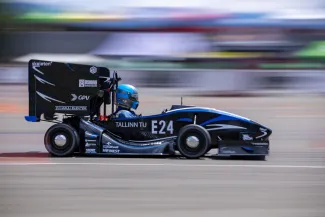
The Formula Student is an international product development competition aimed for the students of engineering and automotive technology. Formula Student Team Tallinn designs, manufactures and competes a high-performance formula car every year, utilizing cutting-edge technology and engineering principles. The car participates in Formula Student product development competitions all over Europe. Formula Student Team Tallinn has been driving the race since 2006. The team has won numerous trophies from all around the world.
Technical/scientific Challenge:
Aerodynamical development requires solving computational fluid dynamics (CFD) simulations. External aerodynamics, the type of flow which cars encounter require big domains to reduce interference and very small element sizes near the object (car) surface to capture the flow structures as accurately as possible. Due to these two criteria, the solved mesh sizes become very big. As every cell needs to have its value calculated for every iteration and a single simulation will run up to 1000 iterations, a household computer is no longer sufficient for the task and HPC capabilities are required.
Solution:
The HPC interfaces allow us to transfer the created simulation files to the HPC centres, where a batch job can be created and the HPC hardware will be used to calculate the values of the equations given by the simulation files. Once the simulation files have been solved, they will be saved and are available for the user to download. With almost zero time wasted on the users personal computer, the solved file can be downloaded and reviewed by the engineer, to then design and simulate a next design iteration.
Business impact:
The HPC saves huge amount of available computer time on the users personal computer, as running a 3D aerodynamics simulation will vacate a well specced computer up to a day, rendering it essentially useless. The HPC capabilities also increase the speed of development significantly, since the simulations run faster and multiple simulations can be solved at the same time. Additionally, bigger and therefore more accurate files, which require huge amounts of RAM could be solved only with the HPCs. These aspects hugely improve the aerodynamic development process of our formula student team and allow us to reach the highest of stages.
Benefits:
Increased work rate - multiple concurrent simulations and faster solving times allow roughly 20x more simulations to be run
Increased accuracy of simulations, as more accurate models can be used, which require high computing power
More efficient time usage of the engineer - post-processing and other tasks can be solved while the simulations are running