
Image
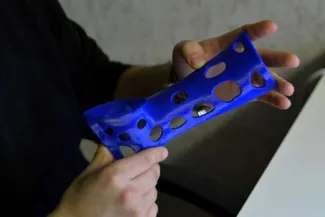
This success story showcases how the Latvian company Ltd. CastPrint, in collaboration with NCC Latvia and leading Latvian research institutions, successfully adopted High Performance Computing (HPC) technologies to optimize the design and manufacturing of custom 3D-printed orthopaedic devices. Through the integration of HPC-powered numerical modelling and topology optimization, CastPrint achieved significant reductions in production time, material consumption, and manufacturing costs while increasing production capacity and improving patient access to innovative healthcare solutions.
Industrial organisations involved
Ltd. CastPrint is the leading custom-made 3D printed assistive device manufacturer in Europe. As such CastPrint has a team of medical engineers, 3D designers and medical specialists - technical orthopaedists and medical doctors.
The University of Latvia is a leading national higher education institution in Latvia. The Institute of Numeric Modelling offers expertise in mathematical modelling and optimisation. The Institute for Mechanics of Materials provides technical capacity for material testing.
Riga Technical University HPC centre provides HPC resources and expertise in HPC software setup.
Technical / Scientific Challenge
CastPrint has been providing custom 3D printed medical devices since 2016, addressing the demand for improved patient-centric solutions. The creation of these devices is challenging due to the complexity of 3D scans and the manual operations involved. This process is time and resource-intensive, often leading to software crashes and data loss. High Performance Computing (HPC) has provided an opportunity to overcome these challenges, enhancing the efficiency and capacity of production.
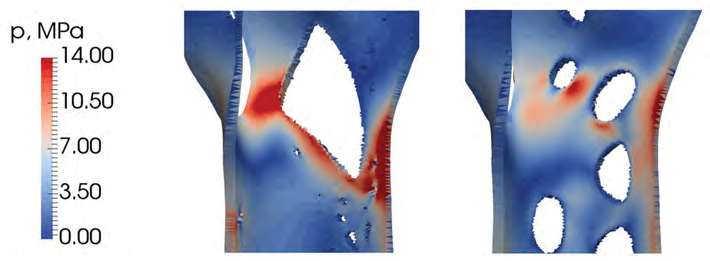
Stress distribution comparison between original and optimized design
Note: The work of the SME was performed within a business experiment funded by the FF4EuroHPC project (*). NCC Latvia supported both the development of the proposal and the execution of the business experiment.
FF4EuroHPC has received funding from the European High-Performance Computing Joint Undertaking (JU) under grant agreement No 951745. The JU receives support from the European Union's Horizon 2020 research and innovation programme and Germany, Italy, Slovenia, France, Spain.
Solutions
The challenge of manufacturing custom 3D-printed medical devices was addressed by incorporating parametric model optimization and HPC tools. The process involved selecting test cases, developing a software system for numerical studies, optimizing model parameters, validating model results, and implementing the model in the manufacturing workflow. The implementation of the project led to reduced design time, material usage, and printing times.
Business Impact
Business
Product delivery time to the end user decreased by 25%. This was achieved through shorter design and printing times for custom 3D-printed medical devices, reducing production costs by up to 15% and increasing production capacity by 25%. Reducing the time between scanning and printing also opened opportunities in new markets.
Society
Shorter printing times and reduced material usage lower production costs, making CastPrint devices more accessible to patients.
Environment
Although CastPrint devices are made from biodegradable polylactic acid (PLA) plastic derived from sugar cane, a 25% reduction in material usage means less plastic waste. Similarly, a 25% decrease in printing times reduces electricity consumption during production. By achieving the goals of this experiment, the project partners contributed to reducing plastic waste and energy use while improving product durability and wearability.
Benefits
- 20% reduction in personnel hours for cast design due to automation
- 25% less material used and 25% decrease in production time after topological optimization
- 15% decrease in production costs and 25% increase in production capacity for CastPrint
Keywords
3D-Printed Assistive Devices, Custom Manufacturing Optimization, Numerical Modelling, Material Testing, Topology Optimization, Orthopaedics, Medical Device Production, Cost Reduction, Healthcare Technology
Industry Sector
Healthcare
Technology
3D Printing, 3D Scanning, High Performance Computing (HPC)
Contact
Mr Kārlis Muižnieks
Coordinator of Collaboration Projects
Email: karlis.muiznieks@lu.lv