
Image
Slovenian National Competence Centre operates within Slovenian National Supercomputer Network – SLING who promotes the use of high-performance computers capabilities for research in science, industry, academia and the provision of public services. The most important task is raising the level of knowledge of users and general awareness of the benefits of using high-performance computers.
Organisations involved:
In silico specializes in numerical simulations of Computational Fluid Dynamics (CFD) for various engineering fields. The company's flagship service, Cloud Towing Tank (CTT), brings advanced CFD expertise to marine engineering. CTT offers comprehensive simulations, including ship resistance, self-propulsion, manoeuvring, seakeeping, and propeller-hull interaction, addressing a wide spectrum of maritime challenges.
Arctur is a privately owned company specialising in advanced and innovative IT solutions, with a strong focus on R&D. For over 25 years, Arctur has been providing exceptional Cloud and HPC services on its cutting-edge infrastructure with a team of experienced engineers.
Technical/scientific Challenge:
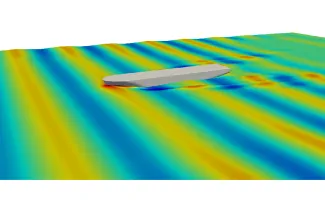
Optimizing a container ship's hull for both calm water and added resistance in waves is a complex technical challenge. In calm water, the focus is on reducing resistance to enhance fuel efficiency and speed. This often involves streamlining the hull shape to minimize resistance. However, in wave conditions, additional factors like wave-induced motions, wave reflection and refraction come into play. This demands an iterative approach by employing CFD simulations and HPC resources to balance streamlined shapes for calm water efficiency hull geometry features that reduce added wave resistance.
Solution:
To enhance the hull's performance, a two-stage optimization workflow was applied. Initially, the hull's global geometry parameters were optimized. Subsequently, a localized fine-tuning of the ship's bow was conducted. Furthermore, the employed approach preserved the required displacement of the vessel across all modifications. Testing encompassed three calm water speeds and one in regular wave conditions, analysing 27 variations per stage—totalling 216 CFD simulations. Performance was assessed through a consolidated propulsion power metric. The obtained data was then analysed through a surrogate model, which provided valuable insights into the influence of the selected variables on the vessel's performance, ensuring a robust and informed optimization process.
Business impact:
HPC significantly enhances our operational agility by enabling parallel simulations at a larger scale. The ability to run numerous computations simultaneously reduces the time required for complex analyses, allowing for rapid iteration. This rapid turnaround is crucial for staying ahead in a fast-paced market and meeting client expectations for swift project completions.
The elastic nature of HPC resources aligns perfectly with our project-driven workflow. By leveraging HPC services, we can scale our computing power to meet peak demands without the hefty investment in physical infrastructure. This flexibility ensures we can manage large-scale calculations during high-demand periods efficiently, maintaining smooth and uninterrupted project progression.
This scalability of HPC resources not only optimizes our operational costs but also empowers us to take on larger, more ambitious projects. It alleviates the stress of resource management, allowing us to focus on innovation and quality of service. Consequently, our business is more adaptable, responsive, and capable of seizing opportunities in a dynamic industry landscape.
Benefits:
Drastically cuts simulation time
Lowers operational costs
Enhances design precision
Boosts response to peak demands