
Image
GScan was founded in 2018 to revolutionise inspection, security and medical scanning markets using Muon Flux Technology (MFT). GScan, as the pioneer of MFT having unique IP, tech & sales expertise in the field, is developing a new generation of Non-Destructive Testing (NDT) scanners and tomography systems for infrastructure management applications.
Technical/scientific Challenge:
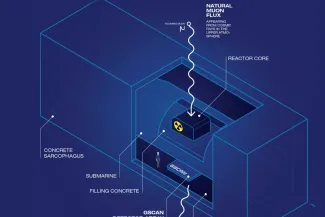
In 1968, Soviet Union built a nuclear submarine training base with two full-length submarines next to Estonian town of Paldiski. The site was handed over to the Estonian authorities, but no detailed specifications about the site were offered. The reactors and radioactive waste have been buried in concrete within the submarine bodies, which are further surrounded by a concrete sarcophagus. 3D scanning, mapping, and performing atomic detection of the now-defunct nuclear reactors were required to decommission these submarines safely.
Solution:
Capitalising on the power of natural cosmic ray tomography, the technology tracks the trajectory changes or absorption of particles (muons, electrons, positrons) as they pass through the object of interest, thereby extracting crucial statistics about its material and shape. These insights are then translated into 2D and 3D visualisations of both internal and external geometries, along with data on chemical composition. The comprehensive output provides in-depth insights into the objects and materials under scrutiny – all meticulously tailored to fulfil customers’ unique requirements. HPC plays an important role in translating the collected data into visualisations.
Business impact:
GScan’s muFLUX Infra detectors can be used for 3D imaging of abandoned nuclear reactors to ensure the safe decommissioning process. In order to minimise the risks of dismantling the site, a high-resolution 3D image and atomic composition analysis is needed. With time and space related digital data in terabytes, the detailed process of reconstruction enables to see inside of structures what was not possible before.
Benefits:
Because HPC accelerates data processing, reconstructions are completed in less time.
With faster reconstruction, it is possible to apply wider range of algorithms during the post processing.
With a wider range of algorithms the capability and efficiency of the technology grows and with better muon flux technology, the world can become safer thanks to more reliable data about critical infrastructure.