Image
Celvia is an Estonian company and Research Institution owned by the University of Tartu, the Tartu University Hospital and the Nova Vita Clinic, among others. Celvia’s mission is to develop and deliver innovative science-based products and services for patients, clinicians and businesses. The company combines new knowledge with state-of-the-art technology and unique skills, resulting in competitive genetic tests that meet high standards. They collaborate with researchers and clinicians from Estonia and abroad to ensure the high quality of basic research.
Technical/scientific Challenge:
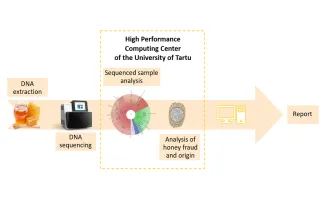
Honey contains approximately 0.01% DNA, which can be extracted and sequenced to produce up to 20 million DNA sequencing reads. These sequences can be computationally analysed using a taxonomic classifier to get insights into the biological composition of honey, aid in monitoring honeybee pathogens, and assess authenticity. However, this computational analysis is resource-intensive as the taxonomic classifier alone relies on a database of approximately 400 GB in size, and the analysis involves multiple steps. The company needs to process a high volume of samples on a weekly basis.
Solution:
Using HPC, the company processes 32 samples in parallel through a singularity containerized Nextflow workflow comprising seven subtasks. The most resource-intensive subtask demands 400 GB of RAM and 8 CPUs per sample. To streamline operations, they have automated the detection of new data, downloading, and initiation of analysis using crontab. Additionally, HPC resources are utilized to securely store raw data and analysis results, ensuring data integrity and confidentiality with backup systems in place.
Business impact:
Honey is one of the most commonly counterfeited foods, creating a significant global challenge. Counterfeit honey is produced at a fraction of the cost of authentic honey, driving down market prices and threatening the livelihoods of honest beekeepers. To address this issue, HPC solutions offer the computational power necessary to analyse large volumes of honey samples on a weekly basis. These analyses help combat honey fraud by verifying authenticity and providing valuable taxonomic insights, enabling beekeepers to better understand and protect the quality of their honey and monitor honeybee health.
Benefits:
HPC computational resources enable rapid processing of large volumes of weekly samples for honey analysis service, reducing results reporting time.
Automation of the analysis process eliminates the need for specialists, allowing office staff to simply download results when notified.
With petabytes of secure storage, HPC ensures safe data storage, including backups and access restrictions.