Image
Overview
The University of Wrocław, through its Institute of Geography and Regional Development, leads the LIFE-MAPPINGAIR/PL project, an information and education campaign titled “Do you know what you are breathing in?”. Its aim is to raise public awareness of air quality, its health impacts and ways to improve it, using the Wrocław and Bydgoszcz agglomerations as examples. The project combines scientific modelling with practical, public-facing tools: forecasts, open measurement data and a MOOC-based educational portal.
Challenge
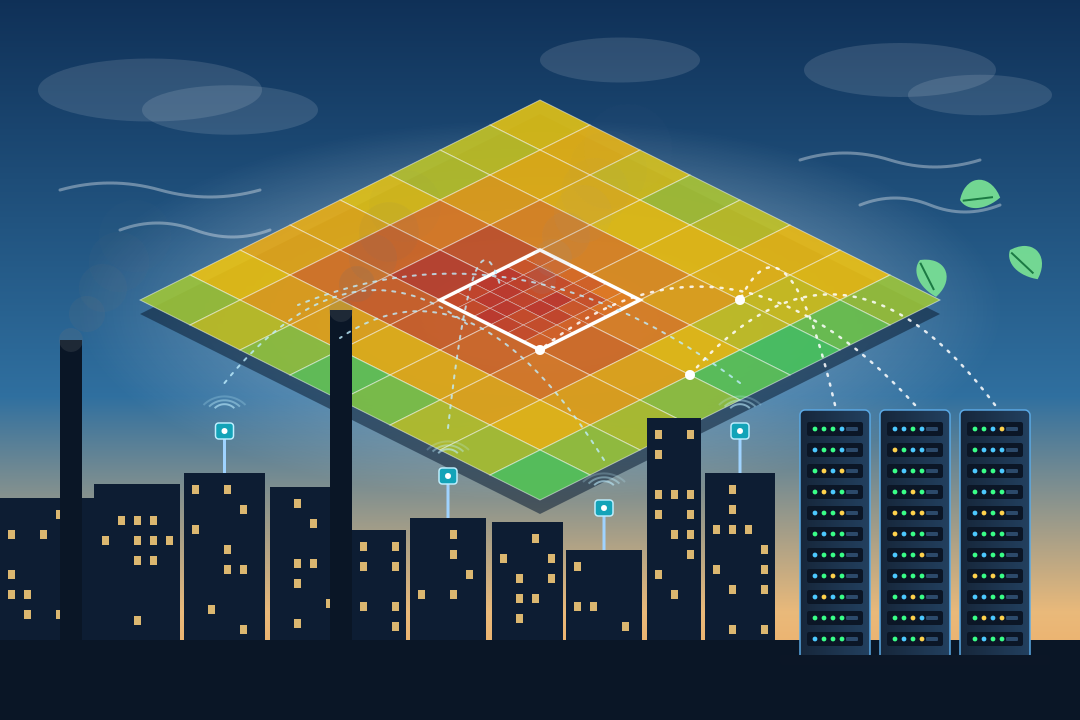
Delivering useful air quality information to the public requires forecasts that are both detailed and timely. The project set out to provide operational 72-hour forecasts at hourly resolution, with a spatial resolution of 4 km for Poland and down to 1 km and 50 m for selected subdomains. This relies on demanding atmospheric and chemical transport models (WRF-Chem, EMEP and uEMEP), which must run on a regular schedule and be ready for public release. Beyond raw computing power, the project also needed capacity to process, visualise, publish and archive large volumes of model and sensor data. It also needed a team with the expertise to develop, implement and maintain the forecasting chain.
Solution
The project uses the computing resources and expert support of the Wrocław Centre for Networking and Supercomputing (WCSS). HPC infrastructure supports five main tasks:
- Operational air quality forecasting, currently with WRF-Chem, with EMEP and uEMEP models and combined forecasts in preparation
- Processing and visualisation of modelled spatial data for the forecast geoportal (prognozy.uni.wroc.pl)
- Archiving of modelling results
- Processing, archiving and sharing of data from an open network of 40 low-cost sensors in the Wrocław and Bydgoszcz areas (airquality.uni.wroc.pl)
- Hosting the MOOC educational platform (mooc-life.e-science.pl), which integrates courses, training and the project’s information tools
WCSS also works with the project team to optimise computational workflows and the way data is visualised and made available to the public.
Results
The collaboration has delivered a set of public tools:
- A portal with air quality forecasts for Poland, based on WRF-Chem: http://prognozy.uni.wroc.pl
- A portal with data from the open sensor network: http://airquality.uni.wroc.pl
- An educational portal with MOOC courses and tools on air quality: https://mooc-life.e-science.pl
Working with WCSS reduces the computing time needed to run and maintain forecasts operationally, makes it possible to use the temporal and spatial resolution required for accurate forecasting, and ensures the scalability of the solution as the project develops.
Impact
This use case shows how HPC can serve the public good, turning complex scientific modelling into accessible, actionable information for citizens. By supporting reliable, high-resolution forecasts and open data, WCSS helps increase environmental awareness, public understanding of the health effects of air pollution, and acceptance of and involvement in actions to improve air quality. In the words of the project team, WCSS is “an excellent partner for both scientific tasks and application tasks related to the dissemination of knowledge and access to socially relevant information.”

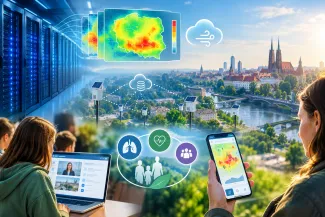
The title image of this article was generated with AI.