
Image
PRIOT Digital Systems (https://priot.io/) is a Slovenian R&D company founded in 2019, focusing on Industry 4.0, IoT, and remote sensing. PRIOT won the CASSINI hackathon (national and EU) and myEUSpace Idea Track for early bark beetle detection. The company partners with Slovenian Forest Service, universities, and research institutes. PRIOT's ESA-funded project "Early Bark Beetle Detection Using Deep Learning" demonstrates AI-driven forest health monitoring using Sentinel-2 satellite imagery.
Technical Challenge
Early detection of spruce bark beetle infestations before visible canopy damage. Traditional field surveys detect outbreaks too late. The challenge requires processing large-scale Sentinel-2 time-series data (2017–2025) across multiple European regions, extracting NDII signals, and training deep learning models (Transformer, LSTM, GRU, TCN) to identify stress onset breakpoints. This demands HPC for processing huge amount of satellite imagery, training complex neural networks on multi-year time-series, and enabling rapid inference for operational deployment.
Solution
HPC infrastructure enabled efficient processing of Sentinel-2 time-series data across Slovenia, Italy, and Germany. Deep learning models (Transformer, LSTM, GRU, TCN) were trained on NDII time-series to detect breakpoints indicating bark beetle stress. HPC accelerated data preprocessing, model training and evaluation. The Transformer architecture achieved the best performance, detecting outbreaks with high temporal precision. Models were validated across multiple regions, demonstrating cross-regional transferability. HPC resources enabled rapid iteration, model comparison, and large-scale inference for generating forest health maps across extensive areas of interest.
Business impact
Bark beetle outbreaks have intensified since 2014, causing record sanitary felling across Central Europe. Traditional monitoring is labor-intensive, limited in coverage, and detects infestations only after visible canopy damage, resulting in significant economic and ecological losses.
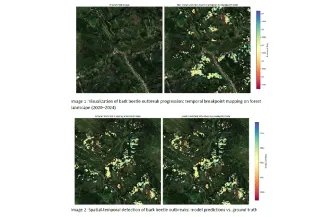
Using HPC for deep learning training enabled rapid analysis of satellite time-series data, showing how bark beetle outbreaks evolve temporally and spatially. HPC accelerated data processing and model training, allowing analysis of multi-year datasets and validation across multiple European regions much faster than standard computing.
The project focuses on developing early detection to identify bark beetle stress before visible symptoms. This would enable forest managers to implement targeted interventions, reducing infestation spread and economic losses. HPC is essential for processing large satellite datasets and training complex models efficiently, making this approach viable for operational forest management.
Benefits:
• Time savings: Automated processing enables monitoring large forest areas in days instead of months
• Cost reduction: Early detection minimizes sanitary felling costs and prevents spread
• Scalability: