
Image

NCC Bulgaria is the National Competence Centre for HPC and HPDA, operating within the EuroCC3 network and EuroHPC ecosystem. Coordinated by the Institute of Information and Communication Technologies at the Bulgarian Academy of Sciences (IICT-BAS) in partnership with Sofia University “St. Kliment Ohridski” (SU) and the University of National and World Economy (UNWE), it supports industry, academia, and public organizations through specialized training, consulting, technical expertise, and access to national and European HPC resources.
Scientific partners involved
The Institute of Information and Communication Technologies (IICT-BAS) conducts fundamental and applied scientific research in the fields of high-performance computing (HPC), machine learning, big data processing, cybersecurity, optimization, financial modeling, and mathematical modeling. The developed methods and technologies find application in medicine, ecology, industry, transport, financial analysis, process optimization, and digital transformation.
Technical/scientific Challenge
Constructing reliable investment portfolios requires balancing expected returns, market volatility, and potential losses under adverse market conditions. For a diversified universe of 32 global financial assets, the large number of possible allocations makes constrained portfolio optimization computationally demanding. An additional challenge is that different risk measures, such as the Sharpe ratio and Mean-Conditional Value-at-Risk (CVaR), may favour substantially different investment strategies. Portfolio decisions are also sensitive to the historical estimation period and the numerical sampling method. The scientific challenge is to evaluate the accuracy and efficiency of stochastic optimization, using Monte Carlo (MC) and randomized quasi-Monte Carlo (QMC) algorithms, to identify how investment objectives and changing market conditions affect the risk and return characteristics of a portfolio.
Solution
Researchers at the Institute of Information and Communication Technologies of the Bulgarian Academy of Sciences (IICT-BAS) developed a reproducible Python-based framework for stochastic portfolio optimization using the HEMUS supercomputer. The methodology compares classical Monte Carlo sampling with Mersenne Twister (MT) and randomized Quasi-Monte Carlo methods based on scrambled Sobol and randomized Halton sequences. Candidate portfolios are generated under full-investment and long-only constraints, with a maximum allocation of 30% per asset. We investigate two optimization objectives: maximizing the Sharpe ratio to improve risk-adjusted returns and Mean-CVaR optimization to limit losses in the worst 5% of monthly observations. The analysis considers three historical estimation windows of 3, 5, and 10 years and five candidate budgets ranging from 128 to 2048. We evaluate each configuration through 50 independent randomized repetitions and compare it with deterministic numerical benchmarks using approximation errors, portfolio characteristics, and execution times. This computational framework enables systematic analysis of how sampling techniques, risk objectives, and historical periods influence portfolio selection.
Scientific impact
Methodology and Computational Framework
The research presents a reproducible Python-based framework for stochastic portfolio optimization, implemented on the HEMUS supercomputer at IICT-BAS. The study examines 32 global financial assets across 3-, 5-, and 10-year historical windows, comparing Monte Carlo (using the Mersenne Twister pseudorandom generator) and randomized Quasi-Monte Carlo (using scrambled Sobol and Halton) methods for Sharpe ratio maximization and Mean-CVaR optimization. The numerical investigation combines replicated MC/RQMC benchmarking with complementary Monte Carlo portfolio simulations. The latter examine larger candidate sets, reaching 20,000 portfolios, and compare Sharpe-oriented allocations with Mean-CVaR strategies. Together, these experiments provide insights into approximation accuracy, computational efficiency, portfolio diversification, and sensitivity to historical market conditions.
- Experiment 1 - Accuracy and Convergence of Stochastic Portfolio Search: Five sampling budgets (128-2048 candidate portfolios) and 50 independent repetitions per configuration were evaluated against deterministic numerical benchmarks. Increasing the sampling budget reduced approximation errors, while differences between sampling methods remained modest, with classical Monte Carlo generally requiring less execution time. Complementary simulations with up to 20,000 candidates illustrated how broader search can identify portfolios with more favourable objective values, although individual results remain dependent on the sampled portfolios.
Experiment 2 – Sharpe-Ratio Optimization Across Historical Windows: Monte Carlo simulations were conducted for 32 global financial assets using 3-, 5-, and 10-year historical estimation windows. As illustrated in Figure 1, the 5-year Sharpe-oriented portfolio achieved the highest expected return of 9.24%, accompanied by annualized volatility of 13.27% in the 100-candidate experiment. Additional simulations with up to 20,000 portfolios demonstrated how increasing the sampling budget can identify higher-return Sharpe-oriented candidates.
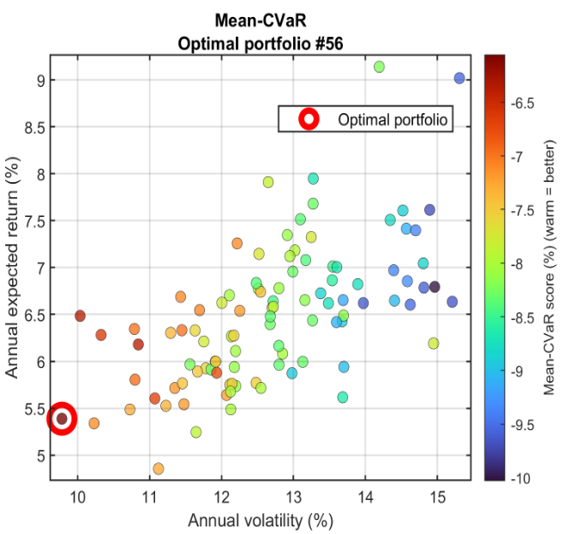
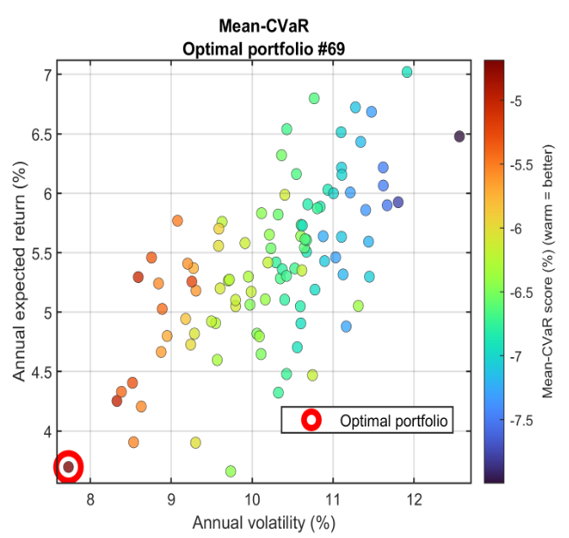
Experiment 3 – Mean-CVaR Portfolio Optimization: The experiments investigated downside-risk-oriented allocation strategies under different historical periods. Figure 2 presents the 100-candidate Mean-CVaR comparison, where the 10-year portfolio achieved the lowest annualized volatility of 7.67%, while the 5-year portfolio offered the highest expected return of 5.40%. The extended experiments also showed that increasing the number of candidates does not necessarily lead to monotonic changes in expected return or volatility.
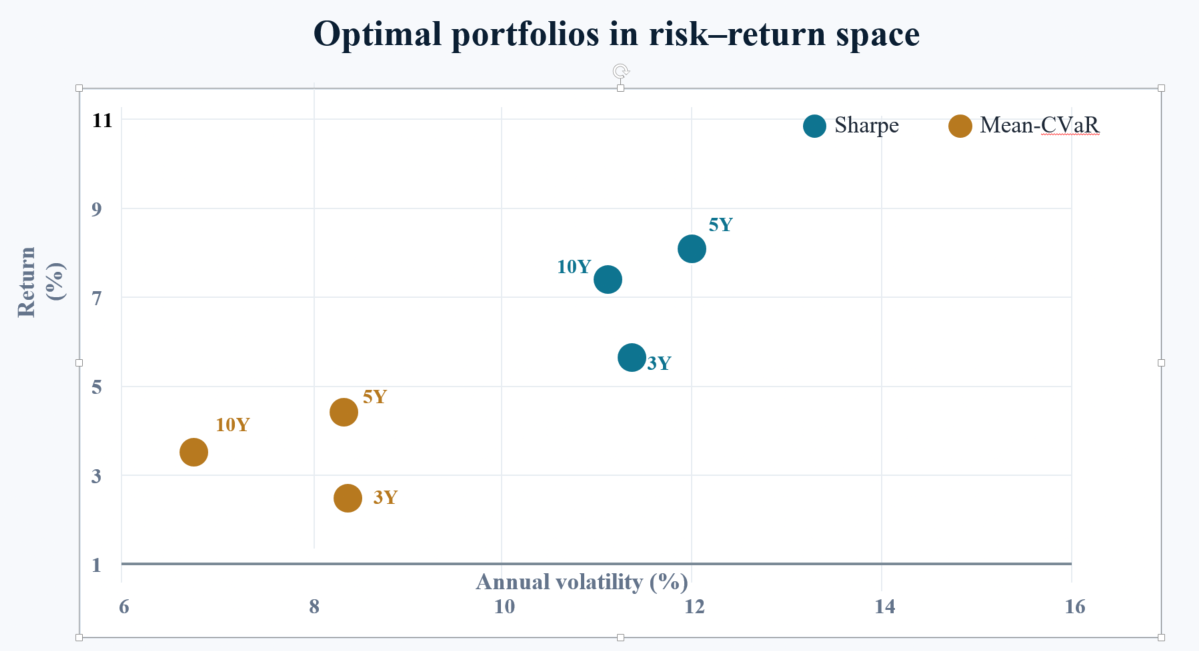
Experiment 4 – Comparative Risk–Return Analysis: Comparing Sharpe and downside-risk-oriented portfolios revealed substantial differences in investment characteristics across historical estimation windows. Figure 3 illustrates how the selected Sharpe-oriented portfolios generally favour higher expected returns and volatility, whereas CVaR-oriented solutions occupy more conservative regions of the risk-return space. These findings demonstrate that optimization objectives and historical periods influence portfolio selection more strongly than the relatively modest differences observed between sampling generators in the replicated benchmark.
Scientific Contribution
The study establishes a reproducible HPC-supported methodology for analyzing stochastic portfolio optimization, numerical convergence, and financial risk-return trade-offs. HEMUS enabled extensive computational experiments and systematic comparisons of investment strategies, providing a foundation for future financial decision-support systems. The results also highlight the importance of further investigations involving transaction costs, rolling-window validation, and out-of-sample portfolio performance.
Benefits
Improved optimization accuracy: Larger sampling budgets reduce approximation errors relative to deterministic benchmarks.
Risk-aware portfolio selection: Compares return-oriented Sharpe optimization with downside-risk-focused CVaR.
Reliable numerical benchmarking: Evaluates accuracy, stability and computational efficiency across MC/RQMC methods.
Better understanding of market sensitivity: Reveals how historical estimation windows influence investment outcomes.
HPC-enabled research: Supports repeated simulations and scalable numerical experimentation.
Future financial applications: Provides a foundation for computational portfolio analysis and investment decision-support systems.
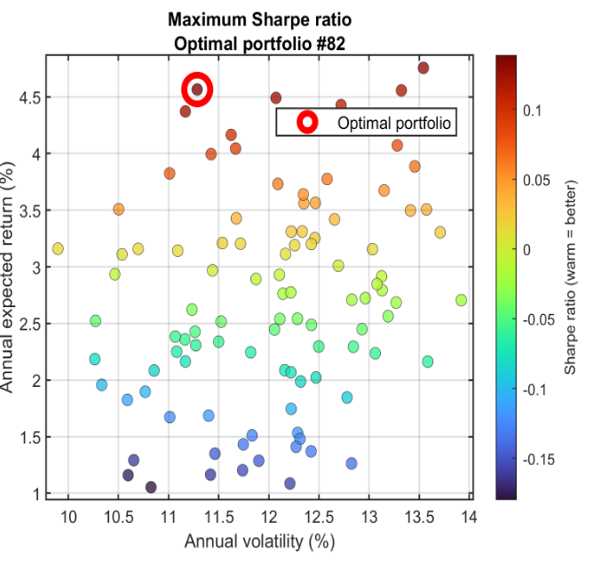
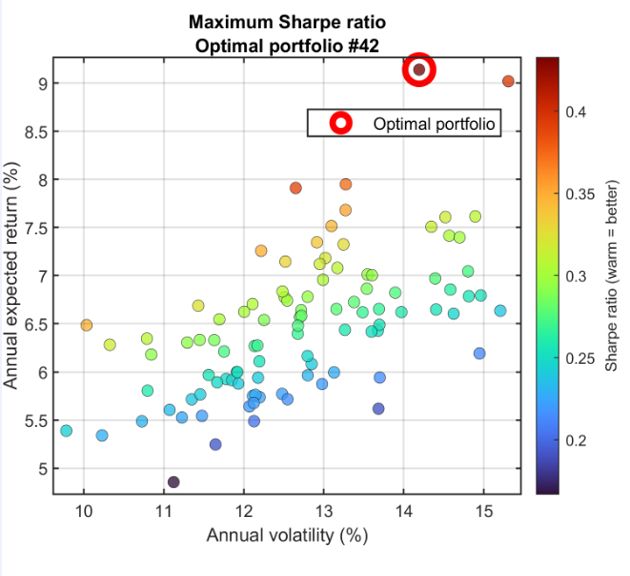
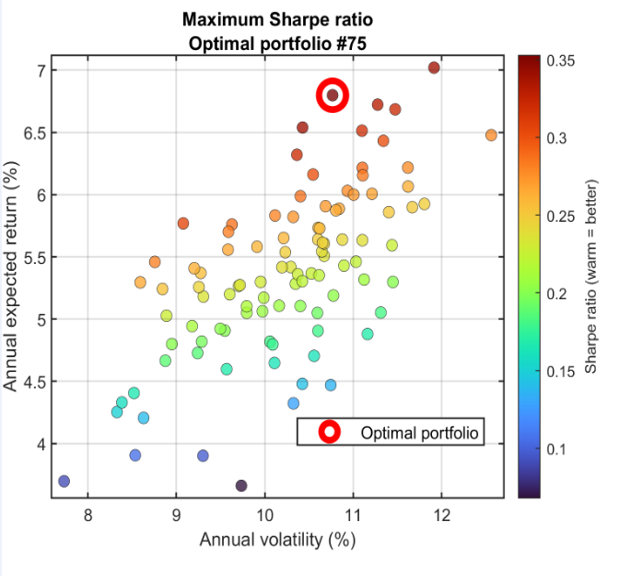
(a) 3-year horizon (b) 5-year horizon (c) 10-year horizon
4.61% return; 11.26% annual volatility 9.24% return; 13.27% annual volatility 6.24% return; 10.80% annual volatility
Figure 1. Sharpe-ratio optimization for 3-, 5-, and 10-year historical windows using 100 Monte Carlo candidate portfolios. The 5-year configuration achieves the highest selected expected return, accompanied by higher volatility.
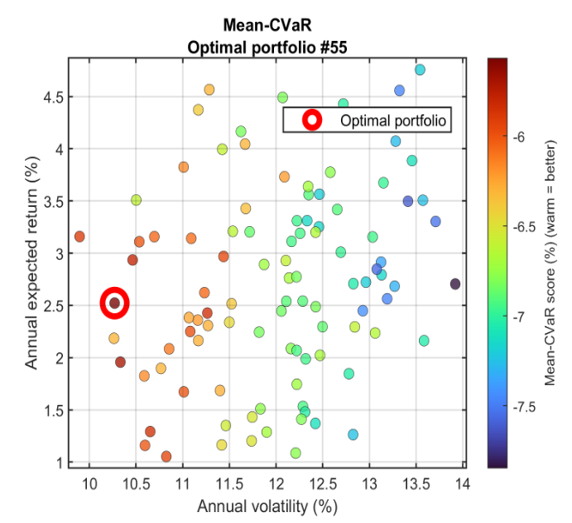
(a) 3-year horizon (b) 5-year horizon (c) 10-year horizon
2.50% return; 10.26% annual volatility 5.40% return; 9.85% annual volatility 3.65% return; 7.67% annual volatility
Figure 2. Mean-CVaR portfolio optimization for three historical estimation windows using 100 Monte Carlo candidates. The 10-year window produces the lowest annualized volatility, while the 5-year window yields the highest selected expected return.
Success story # Highlights
Keywords: HPC; Monte Carlo; Quasi-Monte Carlo; Portfolio Optimization; Sharpe Ratio; CVaR; Financial Risk.
Technology: HEMUS Supercomputer; Python; Mersenne Twister; Scrambled Sobol and Halton; Stochastic Optimization.
Industry sectors: Finance/Insurance; IT/HPC Systems, Services & Software Providers.
Scientific achievement: Development of a reproducible HPC-based framework for comparing stochastic portfolio optimization methods.
Key results: Larger sampling budgets improved numerical accuracy, while optimization objectives and historical windows significantly influenced portfolio risk–return characteristics.
HPC contribution: HEMUS enabled repeated simulations, algorithm benchmarking and computational performance analysis.