
Image
The HPC Competence Center (HPC CC) was established in 2020 and is operated by the Digital Government Development and Project Management Company (Digitális Kormányzati Fejlesztés és Projektmenedzsemnt Kft., DKF). It promotes the High Performance Computing (HPC) and introduces the HPC infrastructure to potential academic and industrial users. Our experts assess the incoming project applications and manage the appropriate allocation of national HPC capacities. Additionally, the Competence Center maintains contact with users and international professional partners and represents the Hungarian HPC infrastructure and community in international professional forums.
Established in 2020 and operated by the Digital Government Development and Project Management Company, the HPC Competence Center (HPC CC) provides supercomputing infrastructure access to academic and industrial users in Hungary. Its key priorities include evaluating project applications, offering comprehensive user support, and ensuring fair allocation of HPC resources based on the anticipated scientific impact of proposed research. Additionally, HPC CC maintains close professional relationships with users, creating opportunities for them to share results and experiences at national and international professional forums.
Industrial organisations involved:
DeltaBio 2000 Ltd. ((https://deltabio.eu/) is a pioneering genomics and molecular diagnostics company with over 15 years of experience in the field. Utilizing next-generation sequencing (NGS), the company operates five sequencers and maintains a diverse team of molecular biology, sequencing, and bioinformatics experts.

Technical/scientific challenge:
The integration of next-generation sequencing in cancer diagnostics has revealed thousands of missense variants, many of which are classified as variants of uncertain significance (VUS) due to their unknown effects on protein function and disease risk. Although numerous algorithms have been developed to classify VUS, few rely on protein structure-based features. This project aimed to expand the pool of available mutated protein structures using AlphaFold2, the Nobel Prize-winning algorithm for protein structure prediction. However, the process of generating thousands of native and mutant structures of clinically relevant genes within 6-12 months posed a major computational challenge. Running AlphaFold2 on a standard computer is complex, requiring over 2.6TB of disk space and intensive CPU and GPU computational power for multiple sequence alignment, model generation, and relaxation steps. Access to the Komondor HPC enabled us to timely explore biological questions that are impossible to analyze with conventional computing resources.
Solution:
To predict a final total of 77,713 protein structures (native and mutated), the powerful CPU-only and GPU partitions of DFK's Komondor HPC were utilized. The CPU-only partition, equipped with 184 nodes featuring two AMD EPYC 7763 CPUs each, enabled rapid multiple sequence alignment and structural template searches even for proteins up to 2,500 amino acids long. The GPU partition, consisting of 58 nodes with one AMD EPYC 7763 CPU and four NVIDIA A100 40 GB GPUs per node, enabled the prediction ofAlphaFold2's five model iterations and GPU relaxation for all the proteins in our dataset. Furthermore, the presence of two separate partitions allowed for the utilization of ParaFold (HPC-friendly implementation of AlphaFold2), which further optimized the process by enabling parallel CPU and GPU processing.
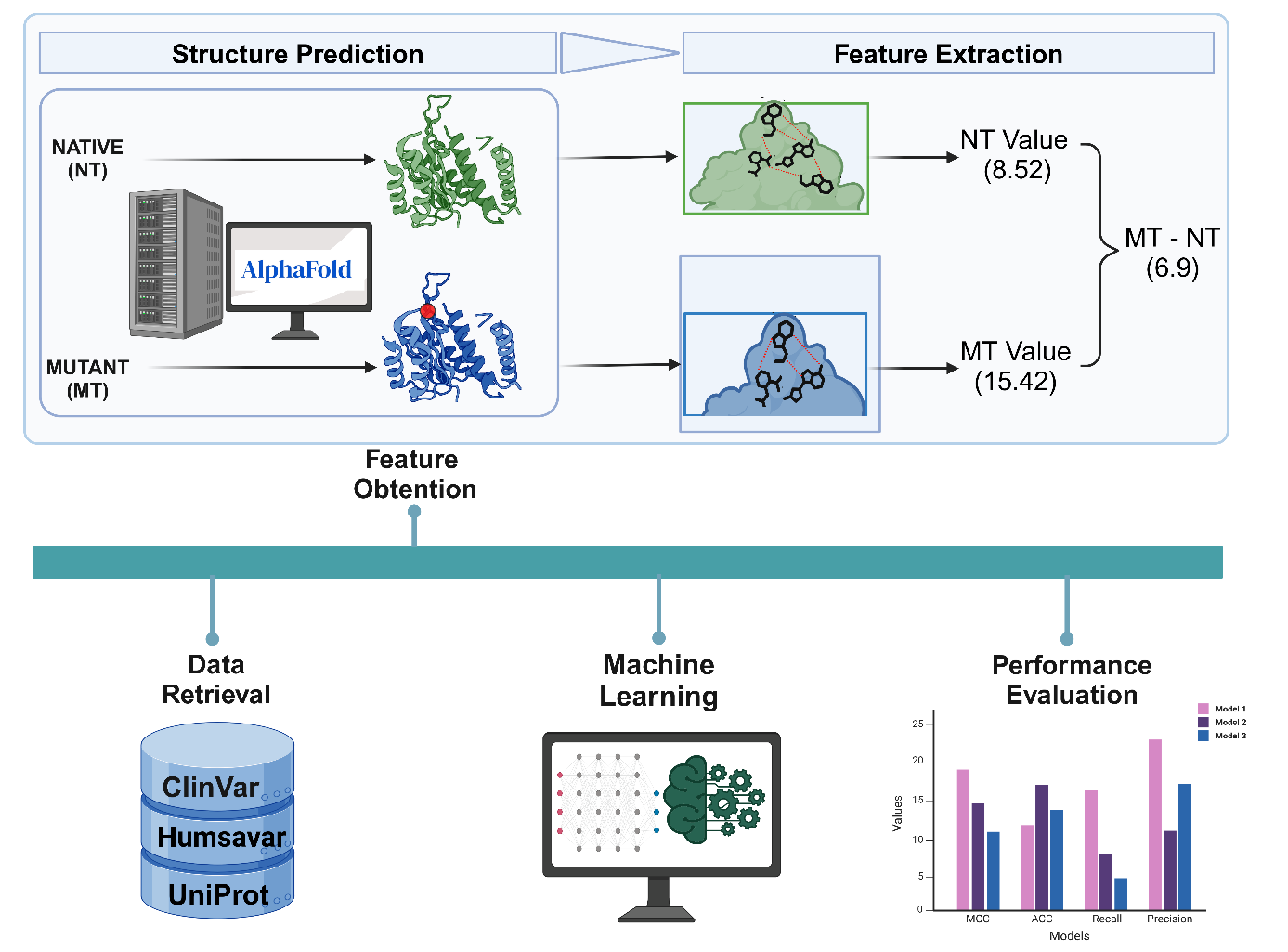
Pipeline of structure prediction of native and mutant proteins using AlphaFold2, structure-feature development and extraction, machine learning training, and evaluation. Created with BioRender. @2024 Erda Qorri.
Business impact:
Having access to the unique information harboured by the mutated predicted structures enabled the bioinformatics team at Delta Bio 2000 Ltd. to develop novel structure-derived features that arenow being used to train machine learning models for interpreting variants of uncertain significance – an ongoing challenge in cancer genomics. Previous efforts focused primarily on the native protein structures, providing a limited perspective. Additionally, this expanded dataset allowed for the establishment of novelcollaborations with other leading European laboratories in the field.
In future steps, Komondor's powerful GPU resources will be essential for testing other approaches like unsupervised learning. As unsupervised algorithms for variant classification gain popularity, integrating them with features derived from the generated protein structures is a key step toward DeltaBio’s goal of developing novel tools for missense variant classification.
The ability to rapidly train, optimize, and evaluate unsupervised models is crucial for Delta Bio Ltd. to remain competitive. This enables the company to identify potential issues early in the training process and quickly respond by resolving them or exploring alternative approaches.
Benefits:
- Time saving: Rapid prediction of >70,000 native and mutated protein structures.
- Pivotal: Enables the exploration of novel biological questions.
- High throughput: Rapid and efficient feature extraction from the generated protein structures.
- Robustness: HPC’s powerful partitions improved the prediction of additional datasets in a short time.
Contact:
Lajos Pinter (lajos.pinter@deltabio.eu) and Erda Qorri (alexandria.kouri@deltabio.eu)
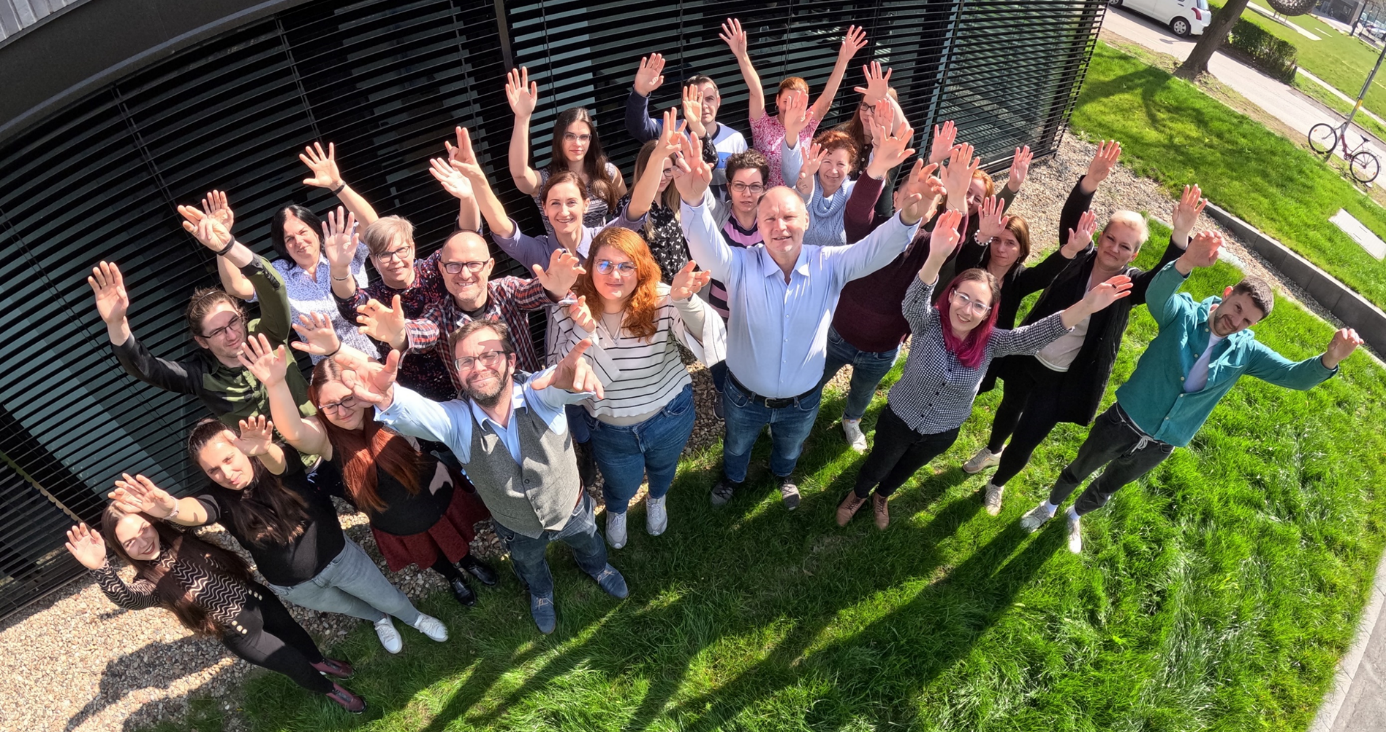
DeltaBio 2000 Ltd. Team. @2024 DeltaBio 2000 Ltd.