
Image

NCC Romania and NCC Netherlands, part of the EuroCC network, worked with RepsMate to evaluate the performance of its AI-based audio processing solution on high-performance computing (HPC) infrastructure. The collaboration involved an initial technical assessment, followed by testing on Snellius, the Dutch national supercomputer, to examine how the application could make use of GPU resources.
Partners involved
NCC Romania is hosted by the National Institute for Research & Development in Informatics – ICI Bucharest, a Romanian research institute specialising in information and communication technology (ICT).
NCC Netherlands is hosted by SURF, a cooperative association that provides digital services and infrastructure to educational and research institutions in the Netherlands. SURF also hosts the country's national supercomputing and storage facilities.
RepsMate develops a Software-as-a-Service (SaaS) solution that uses artificial intelligence and data analytics to analyse customer interactions and assist company representatives in their communication with customers.
The platform combines automatic speech recognition, spoken emotion recognition, behavioural segmentation and real-time contextual guidance. It is designed to provide agents with personalised support during conversations while helping call centre managers better understand customer interactions.
Technical / scientific challenge
RepsMate's solution relies on several machine learning components to process audio recordings and extract information about speech, emotions and behaviour.
Running these components together requires computing resources, particularly when processing large volumes of audio data.
The main challenge was to assess how the different components of the application could operate efficiently on large-scale computing systems. This included examining opportunities for parallel processing on Graphics Processing Units (GPUs) and evaluating the application's suitability for HPC infrastructure.
Solution
NCC Romania carried out the initial assessment of RepsMate's audio processing workflow, focusing on its potential for GPU parallelisation.
The evaluation indicated that the application was a suitable candidate for further testing on HPC infrastructure.
Following this assessment, RepsMate developers were granted access to Snellius, the Dutch national supercomputer, where they conducted medium-scale tests using NVIDIA GPUs.
NCC Netherlands supported the testing activities by providing assistance with performance evaluation and correctness checks.
The results provided information about the application's scalability and its use of computing resources on NVIDIA GPU-based systems.
At the time the original case study was documented, in December 2023, further analysis involving AMD GPUs was underway. This was intended to assess the application's behaviour across different GPU architectures.
A possible next step was to guide RepsMate towards applying for development access to a suitable EuroHPC pre-exascale system.
Figure 1 presents a comparison of processing times between HPC infrastructure and RepsMate's cluster for five processing tasks.
The results indicate shorter execution times on HPC for the evaluated workloads. These measurements relate to the specific tasks and configurations used in the tests and do not represent an overall performance benchmark for the entire RepsMate platform.
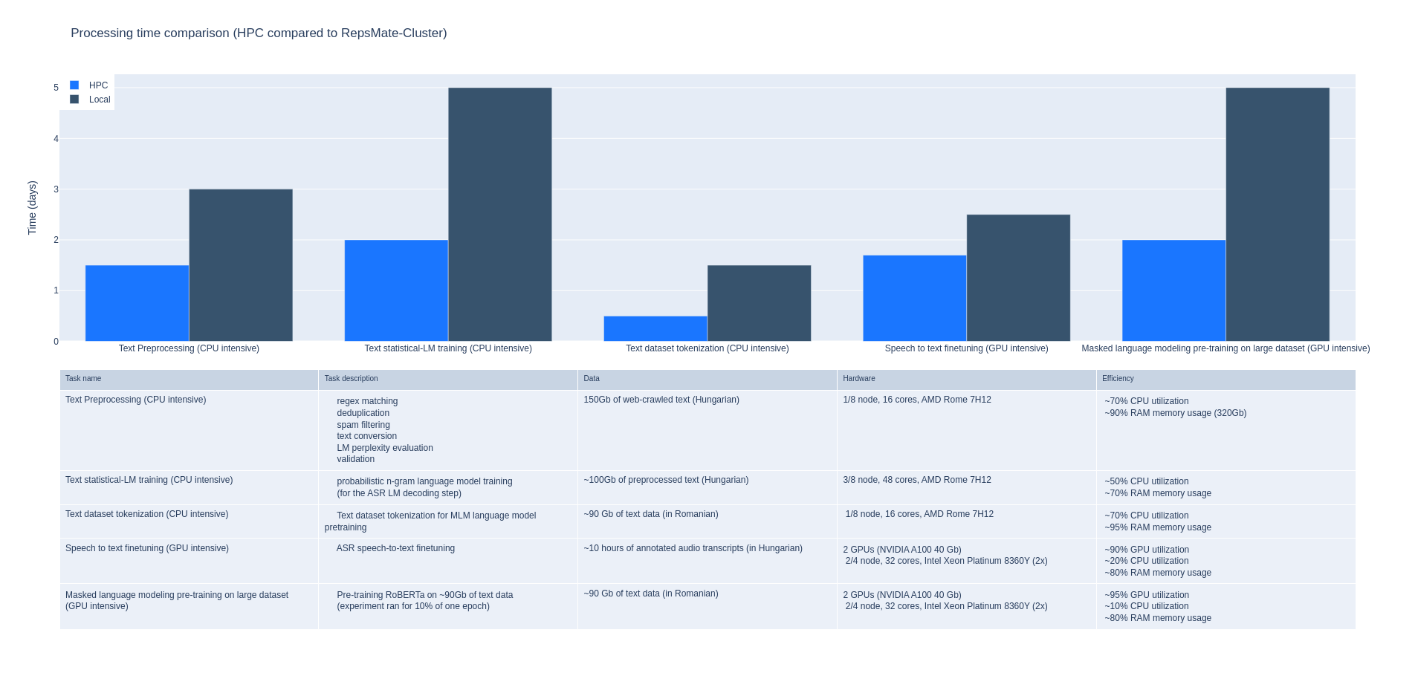
Figure 1. Processing time comparison between HPC and the RepsMate cluster. Source: EuroCC Success Stories, December 2023
Results and impact
The collaboration gave RepsMate a better understanding of how its application performs on HPC infrastructure and how its processing workflow could benefit from parallel computing.
The tests on Snellius provided information about the application's execution on NVIDIA GPUs and its use of available computing resources.
The original evaluation also included a comparison of processing times between HPC infrastructure and RepsMate's own cluster. The results showed shorter processing times on HPC for the workloads included in the comparison.
The assessment helped clarify the computing requirements of the application and provided a basis for considering different HPC architectures for future use.
It also highlighted the relevance of HPC resources for processing large volumes of audio data using deep learning methods.
For RepsMate, these findings offered practical information to support further technical development and decisions about computing resources. The available documentation does not, however, establish specific financial savings or performance improvements across the entire platform.
The case also shows how cooperation between National Competence Centres can give companies access to technical expertise and HPC infrastructure beyond their national resources.
Benefits
- Application assessment: Analysis of RepsMate's audio processing workflow and its potential for GPU parallelisation.
- Access to HPC infrastructure: Medium-scale testing on NVIDIA GPUs using the Snellius supercomputer.
- Performance evaluation: Information about the application's execution, scalability and use of computing resources.
- Technical assistance: Support from NCC Romania and NCC Netherlands during the assessment and testing activities.
- Future HPC use: Guidance on further testing and potential access to EuroHPC pre-exascale systems.