Image
The Institute of Genomics of the University of Tartu is the leading hub of genomics and related transdisciplinary research in Estonia. The Institute of Genomics was established to promote greater synergy between genomic-based research and other scientific fields. The archaeogenomics research group focuses on studying the genetic diversity of modern humans and evolutionary background using genome data from both contemporary and ancient humans in a global and regional context.
Technical/scientific Challenge:
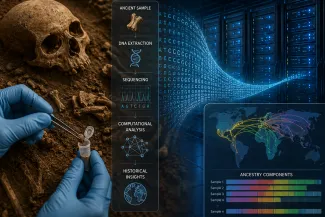
Archaeogenomics aims to trace the migration, adaptation, and interbreeding of ancient human populations. This involves analysing genetic diversity across different geographical regions and time periods. The human genome consists of about 3 billion base pairs, and sequencing technologies generate massive amounts of raw data (often in the range of terabytes or more) that has to be stored, processed, analysed and shared. However, effective analysis and data storage of such huge amounts of data is unthinkable using conventional computers.
Solution:
In archaeogenomics, which focuses on analysing ancient DNA to understand the genetic history of past human populations, high-performance computing plays a crucial role in addressing the unique challenges of working with ancient genetic data. Researchers extract and process biomolecules from archaeological material and soil in the ancient DNA cleanroom and analyse data using the bioinformatics toolbox. HPC systems provided by the University of Tartu HPC centre offer computational power needed to efficiently process and analyse these datasets. HPC enables faster and more accurate genome assembly, alignment, and variant calling, which are key tasks in genomic analysis.
Scientific impact:
The archaeogenomics research group is a partner of Estonian Roots, a Centre of Excellence for transdisciplinary studies on ethnogenesis and cultural diversity. The Centre of Excellence brings together researchers from humanities and scientists to investigate the origins of cultural and genetic diversity in Estonia and neighbouring areas. To understand human demographic history and the spread of epidemics, genetic results are analysed in the context of natural and anthropogenic environments to explore the interactions and co-evolution of biological and cultural evolution. All the necessary DNA analyses are carried out using the facilities of the University of Tartu HPC Centre, illustrating the fact that the project would not be feasible without HPC solutions.
Benefits:
HPC plays a key role in genomic research for efficient handling and processing of large-scale genomic data.
Thanks to powerful HPC solutions, accurate data analysis can be performed in a short time. In addition, population scale analysis can be conducted using HPC.
Flexibility in analytical modules: it is possible to install different modules that allow performing various analyses that are suitable for modern DNA and for ancient DNA.