Image
Industrial organisations involved:
MedInnoScan Research and Development Ltd. has been creating various applications of machine learning and artificial intelligence since 2017 to offer solutions in medicine, such as diagnosis, therapy suggestion, and automated follow-up monitoring. The company has cooperated with more than 100 health care institutions on project such as chronic wound assessment and bandage type suggestion, patient self-monitoring of wounds with alerts generated when indicated, and knee cartilage donor-recipient geometric matching, which is the topic of the current story. They have spun out this project into GenuForm AI Ltd..
Technical/Scientific challenge:
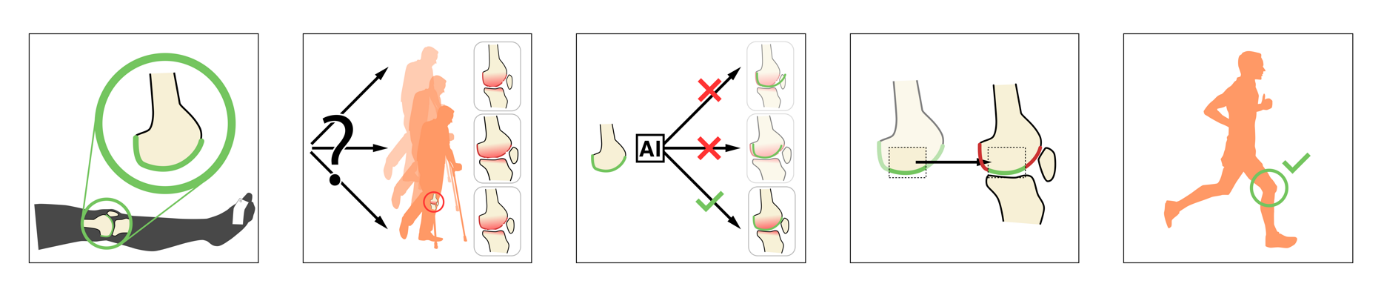
Matching the geometry is of paramount importance when restoring knee cartilage surfaces with transplantation as it‘s a rigid tissue. (Immunology is not a factor for cartilages.) Do it well and the patient regains full function for life. GenuForm’s multi-part AI solution optimizes the matching from MR images and recommends which part of the donor cartilage would best serve which recipient, thus optimizing the match and availability of grafts.
Solution:
The first AI part of GenuForm’s solution determines the existing geometry of the prospective recipient. The second AI part “digitally restores” the damaged cartilage part, it determines what a healthy tissue should look like. The difference between the two provides the required restoration geometry. Margins are added to this to match the available surgical instrument shapes, which yields the final required graft geometry.
The third AI part of the solution determines the existing geometry of the donor when tissue becomes available. The final, fourth part, a combinatorial geometry algorithm then determines if any part of the donor tissue matches the required graft geometry within the provided tolerances. Generally, multiple recipients can be served from one donor cartilage, and the algorithm proposes cutting up the donor tissue into multiple pieces to optimally utilize available tissue while taking provided medical and ethical parameters into account.
Having harvested available tissue from a suitable cadaver, the AI algorithm determines which patients‘ geometries the available tissue would match best © 2024 GenuForm AI
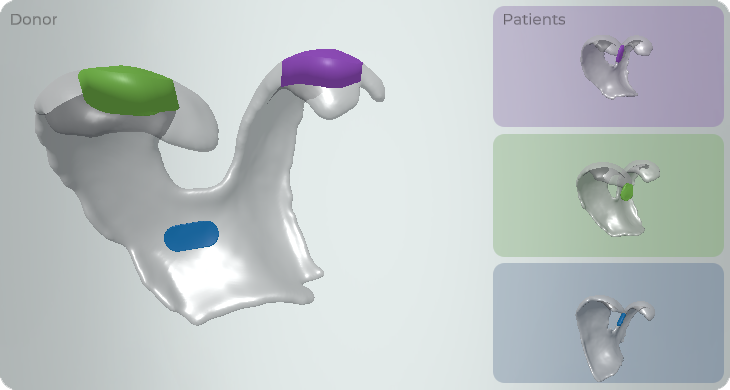
A 3d representation of donor and recipient tissues showing the matched areas © 2024 GenuForm AI
Business impact:
The use of HPC allowed the machine learning algorithm and AI to be trained much more quickly and efficiently. Not only did the calculations run faster but with the vastly increased operating memory available the size of the training set that could be processed in each step was significantly enlarged as well. This allowed for much quicker turnaround times on experiments, greatly increasing the hyperparameter exploration spectrum we could traverse. This finally resulted in the AI algorithm’s superior performance compared to earlier versions trained in more resource limited environments.
Benefits:
- Perfect geometric match enhances operation success probability
- Improves availability of tissue for transplantation
- Efficient use of a scarce resource: one cartilage can serve 2-3 patients in an optimal case
- Ex-vivo time for cartilage is significantly reduced
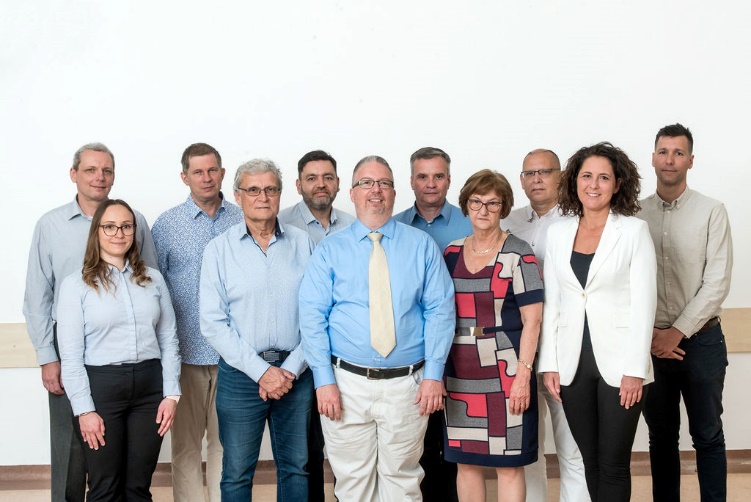
The GenuForm AI team: Peter Szucs, Dora Torok, Endre Szabo, Prof. Dr. Laszlo Hangody, Tamas Frisch, Peter Szoldan, Andras Solti, Dr. Zsofia Egyed, Christian Szegedy, Adrienn Gogo, Dr. Gyorgy Hangody © 2024 GenuForm AI