
Image
NCC Finland
NCC Finland is part of the EuroCC2 project, which establishes national HPC competence centers in different European countries. NCC Finland's mission is to support and improve the capabilities of Finnish business users to utilize the opportunities of high- performance computing, data analytics and artificial intelligence.Through NCC Finland, companies have access to the computing capacity of the EuroHPC LUMI Supercomputer. NCC Finland is operated by the CSC – IT Center for Science.
Industrial organisations involved:
Posiva Oy is the world’s leading final disposer of spent nuclear fuel and is responsible for geological final disposal in Finland. Posiva’s final disposal solution is the result of decades of multidisciplinary development work, part of which involves underground facilities at ONKALO® in the bedrock of Olkiluoto. Posiva´s partner company, Amphos21 Consulting S.L., a company of the RSK group set in Barcelona offers scientific, technical and strategic consulting services for the whole nuclear fuel cycle and in problems related to the presence of radioactive material in the environment.
Technical/scientific Challenge:
Posiva models the evolution of groundwater chemistry in the bedrock for at least 100,000 years as part of ensuring the long-term safety of final disposal. The time span of the final long-term safety assessment is up to one million years. Posiva has been conducting long-term safety analyses and modelling for a long time. It has collaborated with CSC on climate scenarios and molecular modelling, for example. In addition to the LUMI supercomputer located at CSC’s data center in Kajaani, Posiva has used the JURECA supercomputer in Jülich, Germany, and MareNostrum in Barcelona, Spain.
Modelling is constantly being developed. The ongoing OL-STAR project aims to consider all processes affecting the composition of groundwater that occur in the bedrock – both those related to water transport and various chemical reactions.
A supercomputer enables the combination of different sub-models into a single model. The model is extremely complex: there are many variables, the volume of the area under investigation, Olkiluoto island, is large (approximately 70 km³), and the modelling period is up to 120,000 years. The effects of climatic conditions are assessed beyond the next ice age, when Olkiluoto will once again be under the sea. This requires enormous computing capacity – in other words, a supercomputer.
The model is first calibrated using changes in groundwater chemistry and flows that have occurred over the past 8,000 years, which have been determined through comprehensive research. Only then can we model the future,” Principal chemist Tiina Lamminmäki from Posiva explains.
Solution:
Lamminmäki’s colleague Lasse Koskinen from Posiva and partner Amphos21 Consulting S.L., a company of the RSK group set in Barcelona, proposed applying for high-performance computing capacity through the EuroHPC project call. In Europe, the LUMI, JURECA, and MareNostrum supercomputers are capable of this level of computing. Posiva obtained computing capacity from the LUMI supercomputer and currently also utilizes paid LUMI CPU capacity.
Posiva uses the open source PFLOTRAN modeling program (control volume-based code), developed in the United States, to model groundwater in bedrock. No one has ever done such extensive modelling before, so the challenges are recognized.
“Our partner Amphos21 is constantly working on optimisation to ensure that the software works well in LUMI. We are also in constant contact with the PFLOTRAN software developers. We have also had to modify our own working methods, as our modelling is constantly evolving,” Lamminmäki explains.
Business impact:
“LUMI’s enormous computing capacity has been extremely useful to us. We know that it is still more efficient than other supercomputers we have used – among the top 10 of the most powerful supercomputers of the world. There is international interest in the use of LUMI, and we have been able to present our modeling at the international CMWR2024 conference held in Arizona, for example,” says Lamminmäki.
Posiva Solutions sells its expertise and modeling skills internationally. LUMI has opened up new opportunities for this, and increased interest in the company among high-performance computing and nuclear waste management communities.
“Sustainability is at the heart of Posiva’s carbon-free energy strategy, and the basis for all our work. All our operations are considered from a sustainability perspective, so it is extremely important for us. Our tools and product development must also operate on its terms,” says Lamminmäki.
Benefits:
Vast computing power and scalability
Raised international interest in Posivas´s modelling with LUMI
- Use of LUMI sustainability values in line with Posiva´s carbon free energy strategy
Success story # Highlights:
Keywords: modeling long time safety, spent nuclear waste
Industry Sector Final dispose of spent nuclear fuel
Technology EuroHPC LUMI supercomputer, Euro HPC Mare Nostrum, Jureca supercomputer, Pflotran software
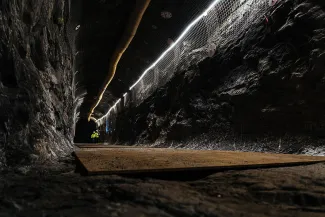
Caption: Final disposal of spent nuclear fuel facility solution, Onkalo in Olkiluoto. Photo Copyright@Posiva
Contact:
NCC Finland : Development manager Dan Still, CSC, dan.still@csc.fi/
Tiina Leiponen, tiina.leiponen@csc.fi