
Image
The Slovenian National Competence Centre operates within the Slovenian National Supercomputer Network – SLING which promotes the use of high-performance computer capabilities for research in science, industry, academia and the provision of public services. The most important task is raising the level of knowledge of users and increasing general awareness about the benefits of using high-performance computers.
Industrial organizations involved:
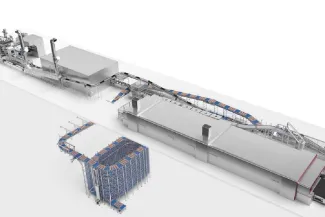
GOSTOL – GOPAN is a global provider of integrated industrial solutions for medium-sized and large industrial bakeries, including equipment for dough mixing, dividing, molding, proofing, baking and cooling. Complete adaptability to the buyer's needs, more than 70 years of experience in the field of baking industry, technically and technologically sophisticated, energy-efficient equipment, innovativeness and reliability are our main qualities.
Technical Challenge:
Various visualizations, animations and high-fidelity visual designs of products the company produces are needed for marketing, exhibitions and presentation purposes. Rendering is done on local workstations which don’t allow processing in a desired timeframe because of the lack of computer resources. The obvious solution is using a GPU cluster and understanding how much can we speed up this process. Blender has been chosen as a software solution since it is free and open-source.
To use multiple GPUs in Blender, it is required to prepare multiple jobs, one for each GPU involved in the computation. In case of a large number of frames to be processed on many GPUs, manual job preparation becomes very time-consuming but also leading to user errors and not optimal resource allocation. For this reason, the automation of job preparation is needed.
Solution:
In this case we wanted to achieve two goals. The first was to demonstrate to the customer that using a GPU cluster is a much faster and cheaper solution than using a powerful workstation. We achieved this by comparing the time needed to finish the same computations on one workstation and on multiple GPU nodes.
The second was to prepare a simple and intuitive application that allows the user to upload the blend file, define the frame range to be rendered and the number of GPU nodes available. The application prepares the job scripts for each node by splitting the desired frame range into multiple sets of frame ranges for each GPU on a single node. This way we can automate the process of job scripts preparation, optimize resources allocation and evenly distribute the workload among nodes and GPUs.
Business impact:
Based on the described PoC, we could demonstrate that using HPC services on pay-per-use billing model instead of using on-premise workstations would have significant advantages for the current customer needs. Various rendering jobs are needed only a few times in a span of one year and at the same time renders are needed fast which is crucial for meeting the deadlines. With more compute power we could also deliver better and more attractive visualizations.
Additionally, the shared nature of HPC resources means that users can scale up their usage as needed, paying only for the compute time they use rather than investing in expensive, high-end hardware that might sit idle during periods of low demand. This flexible usage model can lead to lower overall costs compared to maintaining a powerful local environment. Moreover, HPC environments are optimized for peak usage, ensuring that resources are available when they're needed most. Overall, using HPC not only improves productivity and results but also provides a more cost-effective and scalable solution for demanding creative workflows.
Having an intuitive GUI makes the job preparation easier, faster and resilient to user errors, allowing also non-experienced users to be able of conducting computational jobs on HPC systems.
Benefits:
Simulation time significantly reduced
Lower operational costs
Enhanced graphic visualizations
- Boosted response to peak demands