Image
Who’s Behind HPC in Europe? Meet CASTIEL 3 and the People Connecting Europe’s HPC Community
Behind every strong European network is a team working to bring people, expertise and opportunities together. Meet CASTIEL 3: the project supporting the National Competence Centres (NCCs) and helping make HPC in Europe a connected, accessible and collaborative community.
A European network with a shared purpose
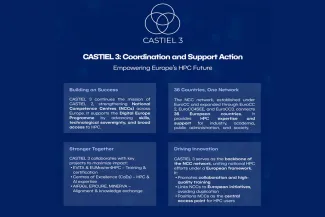
Established through the EuroCC initiative, the NCC network now brings together 36 participating countries across Europe. Each NCC acts as a national point of contact, helping businesses, researchers, public administrations and other interested users access expertise and services in High-Performance Computing (HPC), High-Performance Data Analytics (HPDA) and Artificial Intelligence (AI).
But who is actually behind CASTIEL 3?
What is CASTIEL?
CASTIEL stands for Coordination and Support for the National Competence Centres (NCCs). Since 2020, the project has been working alongside the European EuroCC initiative to strengthen collaboration and support the development of High-Performance Computing (HPC) expertise across Europe.
Now in its third phase, CASTIEL 3 builds on the achievements of CASTIEL 2 and continues its mission of connecting European HPC stakeholders, sharing expertise and creating synergies between national and European initiatives. Its purpose is to support the people and organisations driving HPC forward.
What does CASTIEL 3 actually do?
1. Connecting Europe's National Competence Centres
CASTIEL 3 strengthens collaboration between the 36 participating countries, encouraging knowledge exchange, sharing best practices and helping NCCs learn from each other's experiences.
2. Strengthening training and skills development
CASTIEL 3 supports the development and alignment of training opportunities, working with initiatives such as EVITA and EUMaster4HPC to promote high-quality education and certification approaches.
3. Making HPC more accessible to industry
Many companies, particularly SMEs, have yet to explore the full potential of HPC and AI. Through activities such as the HPC Service Hub, CASTIEL 3 helps connect businesses with relevant expertise, services and technology providers.
4. Making European HPC expertise visible
Through the HPC in Europe Portal, the project helps promote training opportunities, events, services and expertise from across the European NCC network.
5. Building bridges between European initiatives
CASTIEL 3 actively encourages cooperation with Centres of Excellence, AI Factories and other European projects.
Why does CASTIEL 3 matter?
Europe has considerable expertise in HPC and AI. However, this knowledge and experience are distributed across different countries, organisations, research institutions and initiatives. Not every country has the same level of expertise, resources or access to specialised services. Companies may not know where to find the right support, researchers may be unaware of relevant training opportunities, and national initiatives may be addressing similar challenges without fully benefiting from each other's experience.
CASTIEL 3 helps address these challenges. Its role is to connect existing expertise, promote collaboration and ensure that the NCCs can benefit from a wider European network. This includes cooperation with:
EVITA and EUMaster4HPC, particularly regarding training, education and certification.
HPC Centres of Excellence (CoEs), connecting specialised scientific and technical expertise with the NCC network.
AI Factories and AI Factory Antennas (AIFAs), strengthening links between HPC and Europe's growing AI ecosystem.
EPICURE and MINERVA, among other European initiatives, through knowledge exchange and the sharing of best practices.
Industry and SMEs, including through the HPC Service Hub, which helps connect companies with suitable HPC expertise and services.
Why HPC in Europe – and where does CASTIEL fit in?
HPC in Europe is the identity and platform through which the European HPC community can connect, discover opportunities and access support. CASTIEL is one of the projects working behind it and the NCCs, so they can take centre stage.
The goal is not to make CASTIEL a brand that stands above the National Competence Centres. Instead, CASTIEL provides the coordination, collaboration and support that help the NCCs grow, connect and become more visible. Find out more about the National Competence Centres, explore their services and discover what HPC in Europe can offer: https://hpc-portal.eu/
Who's behind CASTIEL 3?
CASTIEL 3 brings together five partners from four European countries. Together, they provide the experience and connections needed to support the European NCC network.
University of Stuttgart (USTUTT), Germany
Project coordination and strategic leadership
The University of Stuttgart, through its High-Performance Computing Center Stuttgart (HLRS), coordinates CASTIEL 3. HLRS brings extensive experience in high-performance computing, supercomputing infrastructure, HPC research and technology transfer.
As project coordinator, the University of Stuttgart oversees the overall implementation of CASTIEL 3, coordinates collaboration between partners and supports alignment with the wider EuroCC initiative and other European HPC activities.
Scapos AG (SCAPOS), Germany
European HPC ecosystem and project expertise
Scapos contributes experience from the European HPC and research project landscape.
Its involvement supports the exchange of knowledge, collaboration between initiatives and the development of synergies across the European HPC ecosystem. Connecting different stakeholders and making existing expertise more accessible are important elements of this work.
Barcelona Supercomputing Center (BSC), Spain
Scientific and technological HPC expertise
The Barcelona Supercomputing Center is one of Europe's leading supercomputing and research centres.
With expertise in supercomputing infrastructure, scientific applications, data-intensive research and Artificial Intelligence, BSC contributes a strong scientific and technological perspective. Its experience helps connect advanced HPC capabilities with research communities and practical applications across Europe.
TERATEC FRANCE (TERATEC), France
Industry engagement and technology transfer
TERATEC brings an important industrial perspective to the consortium. As a French organisation active in HPC, simulation and AI, it connects technology providers, research organisations and industrial users.
Its experience in engaging with companies and promoting HPC adoption is particularly relevant for supporting SMEs and helping businesses understand how advanced computing can address their challenges.
University of Tartu (UTARTU), Estonia
Academic expertise and international collaboration
The University of Tartu strengthens the consortium with its academic expertise in computer science, data science and Artificial Intelligence.
Its involvement contributes to scientific collaboration, digital skills development and the exchange of knowledge across the European academic and HPC communities.
Five partners, one shared mission
Although the partners bring different backgrounds and areas of expertise, they share a common objective: strengthening the European HPC ecosystem by supporting the people and organisations that make it work.
About CASTIEL 3
Project: Coordination and Support for the National Competence Centres (CASTIEL 3)
Duration: 1 April 2026 – 31 March 2029
Consortium: University of Stuttgart (Germany), Scapos AG (Germany), Barcelona Supercomputing Center (Spain), TERATEC FRANCE (France) and University of Tartu (Estonia).
Funding
CASTIEL 3 has received funding from the European High-Performance Computing Joint Undertaking (JU) under Grant Agreement No. 101306918. The JU receives support from the European Union’s Digital Europe Programme and Germany, Spain, France, Estonia.
Funded by the European Union. Views and opinions expressed are however those of the author(s) only and do not necessarily reflect those of the European Union or EuroHPC Joint Undertaking. Neither the European Union nor the EuroHPC Joint Undertaking can be held responsible for them.