
Image
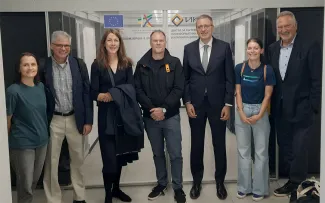
In September and October 2026, the Institute of Information and Communication Technologies at the Bulgarian Academy of Sciences (IICT-BAS) welcomed two business delegations interested in high-performance computing (HPC) and opportunities for collaboration between science and industry. On 30 September 2026, the Institute hosted representatives of Hewlett Packard Enterprise (HPE), TSANet, Microsoft, and other partners. On 14 October 2026, IICT-BAS welcomed an international delegation of 30 representatives from the Digital Sector Group of the Enterprise Europe Network (EEN) from 12 European countries. The delegation was led by Hristina Kasparyan from the Bulgarian Industrial Association. The visitors learned about the infrastructure and applications of the HEMUS supercomputer.
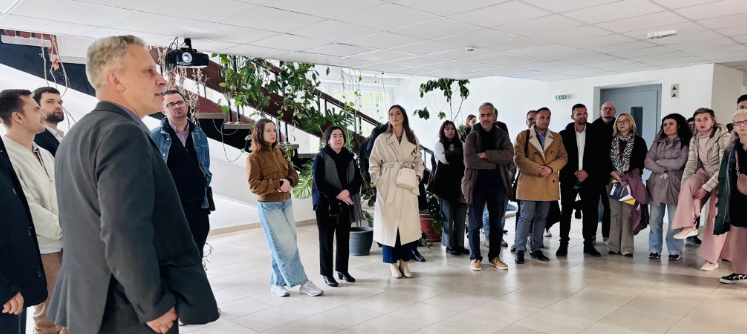
Part of an international business delegation from the European Network visiting IICT-BAS
The central place in the programs of both visits was occupied by the presentation of the HEMUS supercomputer (a system in the Top500 in 2023 and 2024). During the meetings, Prof. Emanouil Atanassov, Head of the Supercomputer Center at IICT-BAS, introduced the guests to the technical characteristics, the possibilities for using the system, as well as the achieved scientific and applied results. The presentations highlighted opportunities to use the supercomputer and the expertise of the Institute's research teams in collaborative projects with businesses. The information presented sparked interest in the potential application of high-performance computing across various economic sectors, including in addressing challenges in the financial sector.
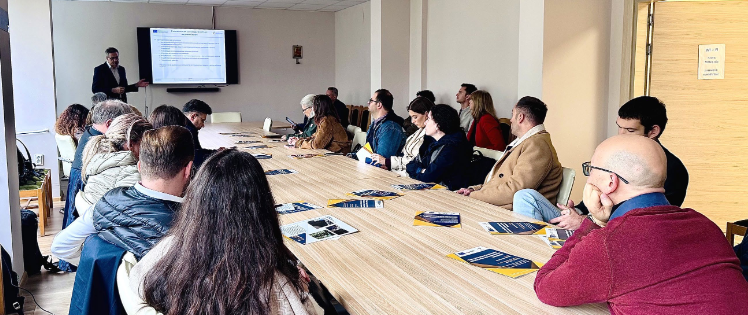
Prof. Emanouil Atanassov also presented the Portfolio of Services of the National Center for High Performance Computing
The high-performance computing capabilities provided by the HEMUS supercomputer allow for the processing of large volumes of data and the solution of complex computational tasks in areas such as artificial intelligence (AI) and machine learning, climate and scientific modeling, bioinformatics, drug development, and research of new materials. For business, these technologies create opportunities for data analysis, modeling of complex processes, risk assessment, and optimization of design and production, supporting the development of innovative products and solutions for real industrial challenges. For the wider application of high-performance computing, IICT-BAS provides consultations, training, and technical support to users in the preparation and optimization of their applications. Prof. Emanouil Atanassov also presented the Portfolio of Services of the National Center for High Performance Computing, with IICT-BAS as the lead organization, which is part of the European network EuroCC3.
Both visits confirmed the importance of direct dialogue between scientific organizations, technology companies, and international business networks for identifying common interests and developing future joint projects. The institute promotes partnerships between science and business and creates the conditions for scientific achievements and high technologies to be transformed into practical solutions for the economy and society.