
About the Quantum in Practice series
Discover the Quantum in Practice series, a continuing program of technical trainings dedicated to exploring the technologies, tools, and real-world applications shaping today’s quantum-computing ecosystem.
Each session features a leading quantum technology provider presenting their platforms, showcasing demonstrations, and guiding participants through practical exercises that illustrate how quantum computing can be applied to industrial and scientific challenges.
The series is structured in two complementary parts:
- a technology introduction open to all audiences, offering an overview of the hardware, software, and potential use cases;
- and an expert segment, focused on solving a specific problem using the provider’s quantum-computing environment.
Whether you are a researcher, developer, or industry professional, Quantum in Practice offers a unique opportunity to gain hands-on insight, technical know-how, and a global perspective on the rapidly evolving quantum landscape.
_____________________________________________________________________________
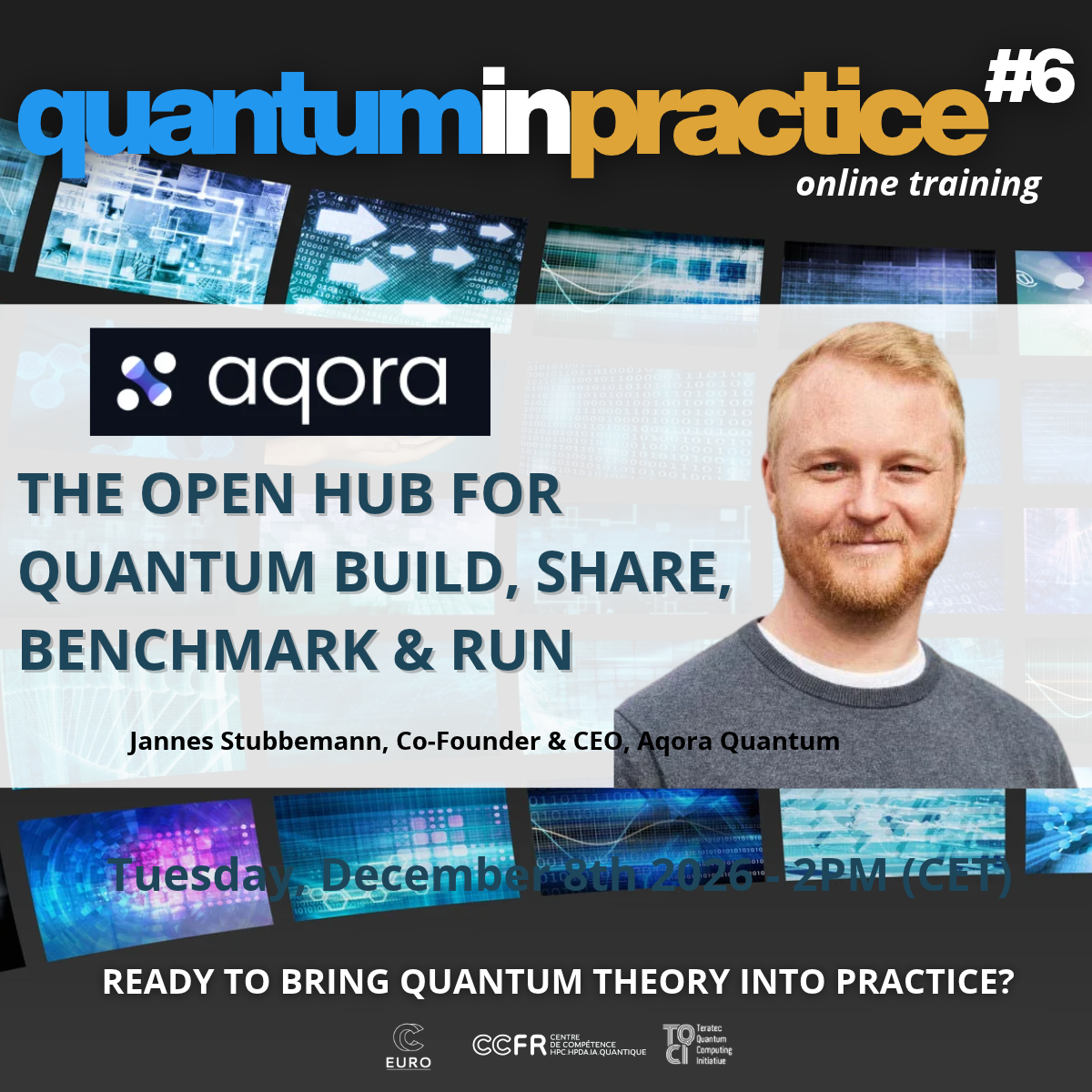
Session – Aqora: The Open Hub for Quantum — Build, Share, Benchmark and Run
Date: December 8th, 2026
Time: 14:00 – 16:00 CET
Format: Online (Webex)
→ Registration: https://teratec.webex.com/weblink/register/r19781380f9dc3aec32ebee82ca386fdf
🎙 Speaker: Jannes Stubbemann, Co-Founder & CEO, Aqora Quantum
Jannes Stubbemann is co-founder and CEO of Aqora, the central hub for quantum computing, where he is building what Hugging Face became for machine learning: a shared place where a field’s data, algorithms and results live and compound.
A computer scientist by training, he previously led PushQuantum, one of Europe’s largest student quantum initiatives, before founding Aqora. He believes the hardest problems in quantum will not be solved by any single team, and that open, comparable results are what turn promising demonstrations into real progress.
Presentation Summary
Most quantum computing results today are one-offs: algorithms are published in papers, datasets remain scattered, and the environments used to run experiments are often difficult to reproduce.
What if quantum computing could follow the same path as machine learning, by bringing data, algorithms and computing resources together in one shared ecosystem?
In this session, Jannes Stubbemann will introduce Aqora, an open hub where researchers and companies can build, share, benchmark and run quantum algorithms in one place.
Through a live demonstration, you will discover how to:
- BUILD: Develop quantum algorithms in reproducible workspaces with fixed environments, regardless of the SDK used.
- SHARE: Publish datasets and algorithms that others can actually run, reuse and build upon.
- BENCHMARK: Compare different approaches on the same problems and datasets, including classical baselines, using reproducible leaderboards.
- RUN: Execute the same code on simulators, HPC systems and quantum hardware from different providers, without rewriting it for each backend.
The session will take you through a complete workflow, from selecting a dataset to running an algorithm on quantum hardware and analysing its benchmark results.
The presentation will also explore what’s next for Aqora: open benchmarks across hardware and cloud providers, and AI coding agents capable of discovering, running and publishing quantum algorithms.
You will leave with practical insights into how to evaluate quantum computing claims for your own problems, how HPC resources and simulators fit into this ecosystem, and how to bring your own use cases and datasets to the platform.
Target Audience
HPC and quantum computing practitioners, R&D engineers, researchers, students and decision-makers interested in evaluating quantum computing solutions.
No prior experience with Aqora is required.
Software Used
Aqora Platform – The central hub presented during the webinar, providing shared datasets, published algorithms, reproducible workspaces, access to simulators and quantum hardware, and benchmark leaderboards.
- Website: https://aqora.io/
- Free account available for individuals.
Aqora CLI & Python SDK – Tools to load datasets, work from your own machine, run experiments and submit algorithms.
- Open source: GitHub – Aqora CLI
- Installation:
uv tool install aqora
Quantum SDKs – Qiskit, PennyLane and CUDA-Q, depending on the examples. The platform allows users to work across different backends without being locked into a single SDK.
About Aqora
Aqora is the central hub for quantum computing. It brings together researchers, companies, algorithms, datasets, hardware and benchmarks in one place.
Inspired by the collaborative model of Hugging Face for machine learning, Aqora aims to make quantum computing results reproducible, comparable and accessible to the wider community.
By providing shared infrastructure for building, publishing, benchmarking and running quantum algorithms, Aqora helps turn isolated experiments into collaborative progress.
Website: https://aqora.io/
Blog: https://aqora.io/blog
GitHub: https://github.com/aqora-io