
Image
Introduction
This demo case demonstrates wind load assessment on buildings using Computational Fluid Dynamics (CFD). Due to the large scale and complexity, such simulation needs HPC resources to achieve timely and accurate results. The simulation is performed using the open-source software OpenFOAM.
In this example case, wind flow over two neighboring high-rise buildings is modeled. This nicely demonstrates how the environment can affect the wind load on a structure. Since wind is a stochastic process, it is necessary to simulate a longer period of time to obtain statistical values (mean, peak) that can be used for the design of structures.
The target audience for this demo case (mainly but not only) is structural engineering offices. Analytical wind load assessment methods are often not capable of being very conservative when designing structures of irregular shape or structures that are placed in unusual environments. The same is true for when designing elements (facade elements) where the wind load can be the decisive factor.
Geometry and mesh
Following the recommendations and considering the size of the buildings (~30x75(h)m) the size of the domain is 550x300x200 meters. The domain and mesh of the case are shown in the following images. With the current mesh refinement settings, the obtained mesh size is ~2.9 million elements.

Simulation results
Simulation examples are designed so that pre-processing and simulations can be performed using OpenFOAM 2.x. Visualization of results can be done using ParaView. The step-by-step instructions are provided in the README file of the repository, which allows any user to potentially run it on any system where software requirements are fulfilled.
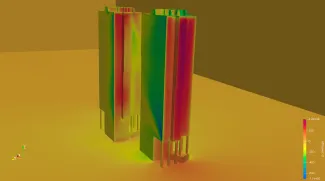
The following images demonstrate examples of post-processed results. For the velocity fields, the values are shown in m/s and for the pressure distribution, the values correspond to the normalized pressure p/rho.

Animation of the wind velocity field in xz plane

Animation of the wind velocity field in xy plane

Average pressure on buildings
More demo-cases, that similarly to this one demonstrate particular HPC solutions to different problems in a simplified yet practical way, are available in a Git repository created by NCC Latvia.