
Image
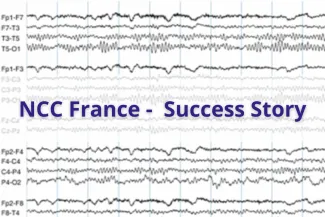
Bioserenity provides diagnostic solutions in the fields of sleep medicine and neurology. Its offering relies on innovative EEG devices (Icecap) enhanced by artificial intelligence, combined with a network of technicians and physicians enabling remote medical interpretation.

Technical/scientific Challenge:
Training large-scale AI models for EEG analysis remains a major challenge due to the complexity, variability, and high dimensionality of electrophysiological signals. The objective of this project was to develop and train an innovative foundation model architecture for EEG data, designed to accelerate the development of EEG-based biomarkers. This new AI architecture aims to improve patient classification performance while providing a scalable and reusable model that can support multiple downstream clinical applications in neurology and sleep medicine.
Solution:
To address this challenge, suitable GPU resources were provided on the ROMEO computing center infrastructure, along with technical support for their effective use. This environment enabled large-scale experimentation and training of the proposed AI architecture. Access to high-performance GPUs made it possible to efficiently train and evaluate the foundation model and to compare its performance against existing deep learning approaches for EEG classification tasks.
Business impact:
Thanks to access to GPU resources at the ROMEO computing center, a new AI architecture could be tested and validated for foundation model construction. The trained model (LBM) demonstrates superior performance compared to conventional deep learning models for classifying pathological patients based on EEG data. These results highlight the potential of foundation models to improve diagnostic accuracy and accelerate biomarker discovery, reinforcing Bioserenity’s innovation capacity in AI-driven medical diagnostics.
Benefits:
- Successful training and evaluation of a novel EEG foundation model architecture
- Improved classification performance compared to standard deep learning approaches
- Acceleration of EEG biomarker development
- Access to 500 GPU hours enabling large-scale experimentation
- Strengthened AI capabilities for clinical applications in neurology and sleep medicine