Image

NCC presenting the success story
NCC Spain
💡🌌A Success Story about the evolution of the Universe💡🌌
📋 "Hydrodynamical resimulations for cosmological inferences" led by Raul Angulo and Francisco Maion from the Donostia International Physics Center (DIPC).
Shortly after the Big Bang, the Universe was extremely hot and homogenous, with very little density fluctuations. As it expanded and cooled, gravity pulled matter together, ultimately leading to the formations of stars and galaxies.
This process can be simulated by evolving a young Universe via supercomputer simulations and, if done with the appropriate physical laws, the result closely resembles the real Universe. But simplifications of these laws are necessary and, as there is not a unique way of making them, this project aimed to perform state-of-the-art galaxy-formation simulations to understand which simulations yield a reasonable Universe and which do not.
CLIENT/USER PROFILE:
Researchers and scientists in the field of cosmology, astrophysics, and computational physics, particularly those involved in simulating the formation and evolution of galaxies and the universe.
IMPACT:
The project has the potential to significantly improve our understanding of the universe's evolution, galaxy formation, and the role of various physical processes in shaping the cosmos.
BENEFITS:
Advancements in cosmological simulations: The project pushes the boundaries of state-of-the-art galaxy-formation simulations, enabling researchers to better understand the complex interactions between matter and energy in the universe.
Improved understanding of galaxy formation: By studying the effects of different physical processes on galaxy formation, the project provides insights into the mechanisms that govern the evolution of galaxies.
Informing future research directions: The results of the project can inform the development of new simulations and models, guiding future research in cosmology and astrophysics.
KEY POINTS BEFORE AGREEING ON THE PROJECT:
Clear objectives: Defining the project's goals, including the specific research questions to be addressed and the expected outcomes.
Computational resources: Ensuring access to sufficient computational resources, such as the MareNostrum5 supercomputer, to perform the required simulations.
Interdisciplinary collaboration: Collaborating with experts from various fields, including cosmology, astrophysics, and computational physics, to ensure the project's success.
TECHNICAL/SCIENTIFIC CHALLENGE:
The project faced the challenge of simulating the complex processes involved in galaxy formation, including the effects of feedback from supernovae and supermassive black holes. The simulations required varying multiple parameters to understand their impact on galaxy formation, which demanded significant computational resources.
SOLUTION:
🖥️ The team studied the "feedback" in these simulations; varying several parameters to understand how their variations affect galaxy formation, among which can be highlighted:
🔹The amount of energy emitted by supernovae in a given amount of time
🔹The amount of energy emitted by the accretion of the supermassive black holes in the centers of galaxies.
They utilized the MareNostrum5 supercomputer from Barcelona Supercomputing Center to perform state-of-the-art hydrodynamical resimulations, varying parameters such as the energy emitted by supernovae and supermassive black holes. The simulations provided valuable insights into the effects of these processes on galaxy formation, highlighting the need to consider additional physical processes to accurately reproduce the observed universe.
The results indicate that no combination of these parameters successfully reproduces the large number of galaxies we see in our Universe while simultaneously expelling the most of their gas from the gravitational well, suggesting that additional physical processes must be considered.
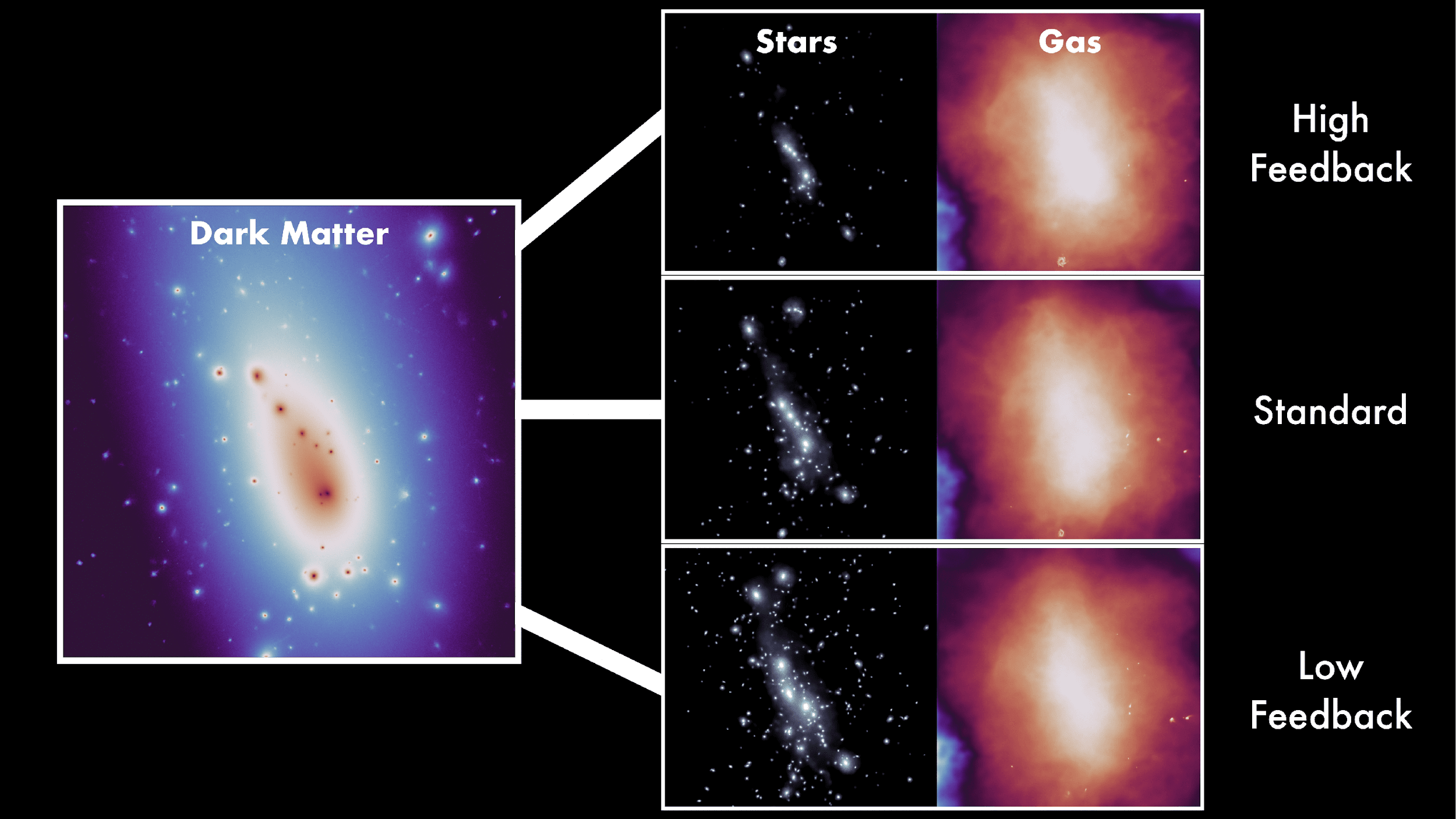
📸 The image shows, on the left side, the dark matter density in the simulated region and, on the right side, the gas and stars present in the region. The simulations shows how:
🔹 With high feedback, a lot of matter gets expelled and there are little stars and galaxies
🔹With low feedback, dark matter is able to attract the gas and form a large amount of stars and galaxies