
Image

NCC Bulgaria was founded by the Institute of Information and Communication Technologies at the Bulgarian Academy of Sciences, Sofia University "St. Kliment Ohridski", and the University of National and World Economy.
NCC Bulgaria is focused on:
- Creating a roadmap for successful work in the field of HPC, big data analysis, and AI;
- Analyzing the existing competencies and facilitating the use of HPC/HPDA/AI in Bulgaria;
- Raising awareness and promoting HPC/HPDA/AI use in companies and the public sector.
Scientific partners involved in the project:
The Institute of General and Inorganic Chemistry (BAS) led the study, bringing expertise in quantum chemistry, reaction mechanisms, and experimental simulation of processes in hydrothermal vents as a plausible environment, where prebiotic reactions take place. The Institute of Information and Communication Technologies (BAS) contributed know-how in high-performance computing, parallel simulations, and workflow optimisation on modern architectures. The Agrobioinstitute (Agricultural Academy) supported the experimental part of the work, analysing the chemical products formed under simulated early-Earth conditions.



Technical/Scientific Challenge:
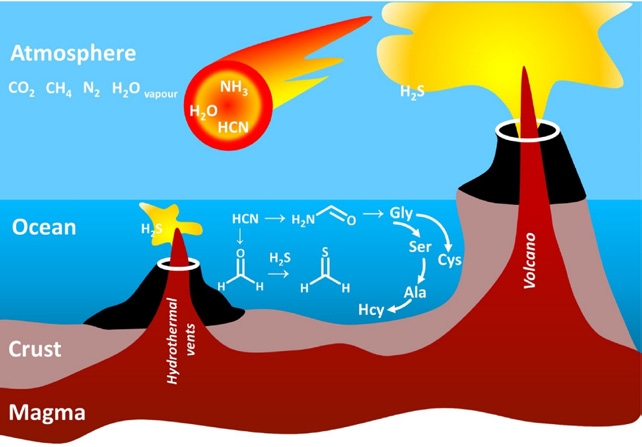
The main challenge was to describe how key amino acids, including sulfur-containing ones, could form abiotically in early-Earth hydrothermal systems from only a few simple molecules such as water, hydrogen cyanide and hydrogen sulfide. This required accurate quantum-chemical modelling of complex multistep reaction networks in water, including transition states and intermediates, under conditions resembling high temperature and pressure. Such prebiotic reactions are characterized by many competing pathways and side reactions, so it was essential to determine which pathways were both energetically feasible and kinetically plausible. At the same time, the team needed to design hydrothermal experiments that could realistically reproduce these conditions and detect trace amounts of crucial intermediates like urea, glycerol and formylglycine.
Solutions:
Using the GAMESS software package on national HPC systems, the team mapped detailed reaction pathways starting from water, hydrogen cyanide/formamide and hydrogen sulfide. They optimised reactants, products and transition states at the SCS-MP2/cc-pVDZ level with a solvation model density (SMD), and followed intrinsic reaction coordinates to confirm the connectivity between reactants and products. The large number of structures and energy evaluations required substantial computing power; running them in parallel on the HPC infrastructure significantly reduced the total time from months to days. In parallel, hydrothermal reactor experiments with formamide-water mixtures were performed to explore the formation of urea, glycine and formylglycine under controlled temperature and pressure.
NCC Bulgaria assisted with setting up and tuning the computational workflow, organising job submissions, and ensuring efficient use of cores and memory, thereby closing the loop between simulation and experiment.
Scientific impact:
In silico, the study reveals non-trivial, energetically feasible routes to form glycine, serine, alanine, cysteine, and homocysteine from only three simple precursors under hydrothermal conditions. It quantifies energy barriers and shows which pathways are kinetically favoured, while ruling out less realistic alternatives. By providing detailed reaction profiles, the work turns qualitative origin-of-life hypotheses into quantitative, testable models. Experimentally, hydrothermal heating of formamide-water mixtures produced urea, glycine and formylglycine, directly validating key intermediates predicted by the simulations.
This strong agreement between theory and experiment supports the idea that hydrothermal vents could have been natural "reactors" for the early synthesis of amino acids and their precursors. The combined approach demonstrates how HPC can guide laboratory design, saving time and resources by focusing experiments on the most promising conditions. Beyond prebiotic chemistry, the methodology developed here - coupling high-level ab initio simulations with targeted experiments - can be reused in other fields such as catalysis, green chemistry and geochemistry. The results provide a mechanistic framework that other groups can build on to explore peptide formation, alternative energy sources and different geochemical settings, and they highlight the strategic role of HPC in addressing long-standing questions about the origin of life.
Benefits:
- Faster screening of prebiotic reaction networks.
- Less trial-and-error in hydrothermal experiments.
- Clear ranking of pathways by energy barriers.
Contact:
Sofia Slavova, Institute of General and Inorganic Chemistry - Bulgarian Academy of Sciences, slavova[at]svr.igic.bas.bg
Nina Stoyanova, Institute of General and Inorganic Chemistry - Bulgarian Academy of Sciences
Sonya Harizanova, Institute of General and Inorganic Chemistry - Bulgarian Academy of Sciences
Ivayla Dincheva, Department of Agrobiotechnology, Agrobioinstitute, Agricultural Academy
Mila Rusanova, Department of Agrobiotechnology, Agrobioinstitute, Agricultural Academy
Sofiya Ivanovska, Institute of Information and Communication Technologies - Bulgarian Academy of Sciences
Venelin Enchev, Institute of General and Inorganic Chemistry - Bulgarian Academy of Sciences