Image

NCC presenting the success story
NCC Spain
🧠💡 Success Story aimed to improve Alzheimer's treatments💡🧠
📋 "Impact of Lipid Cell Composition on Beta-Amyloid Aggregation: Exploring Novel Therapeutic Targets for Alzheimer's Disease" led by Martín Calvelo Souto from Universidade de Santiago de Compostela.
Alzheimer’s disease is a neurodegenerative disorder characterized by cognitive decline and memory loss, primarily associated with beta-amyloid (Aβ) aggregation. However, current drugs targeting Aβ fibrils still have uncertain efficacy, highlighting the need for new strategies.
Since changes in brain cell lipid profiles are associated with Alzheimer's progression, one emerging path is the study of lipid membrane composition. Particularly, the Aβlina project studies how different lipid compositions influence Aβ aggregation by means of Coarse-Grained Molecular Dynamics.
🖥️ Thanks to RES supercomputer #FinisTerraeIII from CESGA, the team performed over 700 simulations of neuronal membrane models, enabling the exploration of large-scale membrane–Aβ interactions.
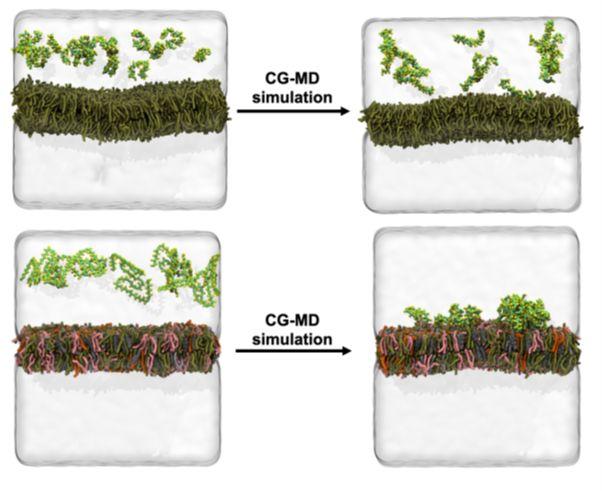
The results revealed that gangliosides enhance Aβ deposition 10 times more than without them. They also found that a key driver of this interaction is the electrostatic interaction between N-acetylneuraminic acid from gangliosides and positively charged amino acids in Aβ.
From these results, the team identified potential strategies to develop new therapeutic possibilities:
🔹Modulating ganglioside levels.
🔹Preventing their clustering in lipid rafts.
🔹 Inhibiting their interaction with Aβ.
CLIENT/USER PROFILE:
Researchers and scientists in the field of Alzheimer's disease, neurodegenerative disorders, and biophysics, particularly those involved in the study of beta-amyloid aggregation and the development of new therapeutic strategies.
IMPACT:
The project has the potential to significantly impact the understanding and treatment of Alzheimer's disease by identifying novel therapeutic targets and strategies to modulate beta-amyloid aggregation.
BENEFITS:
Understanding the role of lipid composition in Aβ aggregation: The project provides valuable insights into the influence of lipid membrane composition on Aβ aggregation, highlighting the importance of gangliosides in this process.
Identification of potential therapeutic targets: The results of the project identify potential therapeutic strategies, including modulating ganglioside levels, preventing their clustering in lipid rafts, and inhibiting their interaction with Aβ.
Advancements in computational biophysics: The project demonstrates the power of computational biophysics tools, such as Coarse-Grained Molecular Dynamics, in understanding complex biological processes.
KEY POINTS BEFORE AGREEING ON THE PROJECT:
Clear objectives: Defining the project's goals, including the specific research questions to be addressed and the expected outcomes.
Computational resources: Ensuring access to sufficient computational resources, such as the FinisTerrae III supercomputer, to perform the required simulations.
Interdisciplinary collaboration: Collaborating with experts from various fields, including biophysics, biochemistry, and neuroscience, to ensure the project's success.
TECHNICAL/SCIENTIFIC CHALLENGE:
The project faced the challenge of understanding the complex interactions between beta-amyloid and lipid membranes, particularly the influence of gangliosides on Aβ aggregation.
SOLUTION:
The team utilized Coarse-Grained Molecular Dynamics simulations on the FinisTerrae III supercomputer to study the interactions between Aβ and neuronal membrane models with different lipid compositions. The simulations revealed that gangliosides enhance Aβ deposition and identified the electrostatic interaction between N-acetylneuraminic acid from gangliosides and positively charged amino acids in Aβ as a key driver of this interaction. The results provide a foundation for the development of new therapeutic strategies targeting gangliosides and their interaction with Aβ.
📸 The image shows the initial (left) and final (right) snapshots of the simulation, displaying Aβ interactions with different lipid membrane compositions — one with gangliosides (bottom) and another without (top).