
Image
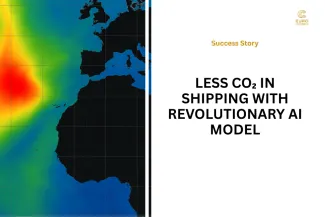
For many, the sea brings calm. But for shipping, it’s a source of unpredictable, weather-driven disruptions. These frequently leads to route changes – which means higher fuel consumption, greater costs, and a heavier toll on the environment. The Greek start-up AlongRoute, with the support of EuroCC Austria, has developed an AI model for the Mediterranean Sea that outperforms traditional weather forecasting tools and helps protect both budget and the planet.
Almost 3% of global greenhouse gas emissions currently come from maritime transport – and the trend is not optimistic. Forecasts suggest that this figure could quadruple within the next 30 years. But there is an efficient way to cut emissions: detect adverse weather conditions as early as possible, adjust routes accordingly, and save fuel. This approach isn’t new – but current weather-based routing systems have a major shortcoming: inaccuracy. They struggle to reflect the chaotic, complex nature of the ocean with any precision. That’s why better forecasting models are urgently needed.
At AlongRoute, this sparked a clear idea: to develop more accurate marine weather forecasts and provide them to software companies offering weather-based route optimisation systems. "The challenge was to improve the accuracy of oceanographic forecasts, particularly predictions of significant wave height (SWH), to help optimise maritime operations", says Vasilis Alexandridis, CTO at AlongRoute. SWH is a critical parameter for shipping: when predicted accurately, it allows captains to adjust course, protect ships and crew from damage, and avoid excessive fuel consumption. AlongRoute collaborated with the Greek AI developer Neuralio to develop the model.
Training AI on Austria’s VSC-5 supercomputer
The team at AlongRoute started by training several AI models on various servers, including cloud platforms. But with over 500 million data points, these systems quickly hit their limits. The project then moved to Austria’s high-performance supercomputer VSC-5. Training was performed on two NVIDIA A100 GPUs with 512 GB RAM each, and completed in just under 14 hours.
“Using the VSC-5’s computing power allowed us to optimise our AI workload,” says Alexandridis. “We could make use of advanced features like Tensor Cores for faster matrix operations, enabling us to process large datasets much more efficiently. Having multiple GPUs meant we could parallelise tasks, which significantly sped up training. The large memory also meant we could load the entire dataset at once – avoiding the need to split it into smaller chunks, which had been very time-consuming on less capable hardware.”
Using Data from the Mediterranean
The team tested various model architectures and settled on a hybrid of Graph Neural Networks (GNNs) and Gated Recurrent Units (GRUs). Training was carried out using oceanographic and atmospheric data from the Copernicus Marine Environment Monitoring Service (CMEMS) and the Copernicus Data Store (CDS), which provided long-term, consistent datasets. The Mediterranean was chosen due to its high-resolution data and suitability for simulation as a semi-enclosed sea environment.
High forecasting accuracy
The results are impressive: the model achieved a mean absolute error (MAE) of 0.0071 on the test dataset – meaning the predicted wave height differed from the actual observed values by just 7 millimetres on average. Even outside the training period*, the model performed well, successfully predicting wave patterns and capturing high-wave conditions with an average MAE of 34 centimetres. The coefficient of determination (R²) on the test data was 0.98, indicating high accuracy and reliability. “An R² of 0.98 means the model explains 98% of the variation in wave height,” Alexandridis explains.
Beating existing forecasting systems
The AI model outperformed current CMEMS forecasts, especially under rough conditions with waves over one metre high. It also achieved a 7% better regression line fit, meaning its predicted values were more consistently aligned with actual wave heights. “These results are transformative for our company – both technologically and commercially,” says Alexandridis. “Working with EuroCC Austria was a truly transformative experience for our team. Access to HPC resources enabled us to train our AI models efficiently and achieve breakthrough results in maritime weather forecasting. The expertise and collaborative mindset of the EuroCC team were key to accelerating the development of our solution.”
About Along Route
AlongRoute Data I.K.E. develops advanced AI models capable of predicting key oceanographic parameters – such as waves, wind and currents – with significantly higher accuracy than current solutions. The start-up’s clients are maritime software providers offering routing optimisation tools. Improved weather forecasting enables shipping companies to respond early to extreme conditions, avoid dangerous routes, and save fuel – benefiting both business and the environment by reducing CO₂ emissions.
Contact
Vasilis Alexandridis: vasilis@alongroute.com
Links
AlongRoute Website and LinkedIn
More on the AI model in the open access article HPC-Driven Oceanographic Predictions with Graph Neural Networks (GNNs) and Gated Recurrent Units (GRUs).
* The training period is the phase during which the AI model is fed data (the training dataset) and learns to predict wave heights. In this stage, the model is exposed to many historical examples and can identify patterns in wave movements. The real challenge begins once the model has completed training and is required to solve previously unseen problems independently. At that point, it is operating outside the training period. This phase is known as generalisation.