
Image
Scientific challenge:
Hadron radiotherapy is currently one of the fastest-developing methods of teleradiotherapy. The high precision of dose delivery and its clinical benefits require a thorough understanding of the processes responsible for the interaction of radiation with living tissue. Modeling the secondary particles generated in nuclear interactions is an area in which great hopes are placed. A better understanding of this process enables advanced treatment planning (by accounting for variable biological effectiveness) and the development of new detectors to monitor the therapy process. A technical challenge is the development of radiation transport simulations, which require significant computational resources.
Project objective:
The aim of the project is to develop computational methods and new types of detectors to improve the effectiveness of hadron radiotherapy. The main tasks involve modeling the interaction of ion beams with matter, the effective application and development of methods based on Monte Carlo simulations, and the analysis of large datasets.
The use of HPC in the project:
Simulations of radiation-matter interactions using Monte Carlo methods are easily scalable. Computational tasks can be divided into any number of subproblems, effectively reducing the total computation time. As a result, simulations that require a long computation time on a single core can be performed much more quickly on a computing cluster, where dozens or even hundreds of cores are available for a single task.
In our case, the calculations requiring significant computational power involve simulating the full range of physical quantities characterizing the treatment plan: radiation doses, the kinetic energy distribution of particles, and their stopping power. Some of these parameters require accurate simulation of nuclear interactions, which, in the Monte Carlo method, necessitates simulating a large number of cases (up to 10^9 particles per task). The calculations utilized popular software packages such as Geant4, FLUKA, and the co-developed SHIELD-HIT12A program.
Thanks to a significant reduction in computation time and the use of parallel computing, it was possible to perform simulations that accounted for the nuclear interactions of the proton beam with oxygen and carbon nuclei. This made it possible to determine the calibration of passive detectors and to simultaneously measure the dose and radiobiological efficacy of clinical proton beams.
Project results:
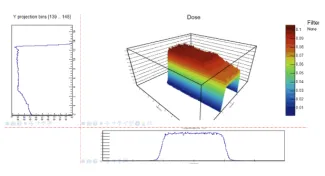
As part of the project, the yaptide project was developed to achieve deeper integration of simulation software with HPC infrastructure, significantly simplifying the process of running and monitoring massively parallel computations for users. The software consists of a browser-based user interface that allows users to submit computational tasks (a single task can utilize up to several hundred processor cores), monitor them, and view the results of the computations. It is one of the few projects enabling secure user authorization and authentication on a computing cluster. The yaptide project is used in research on the simulation of the interaction of radiation with matter, particularly in the field of innovative methods of hadron radiotherapy.
The yaptide project is available to users at https://yaptide.c3.plgrid.pl/