
Image
NCC presenting the success story
NCC Finland is part of the EuroCC2 project, which establishes national HPC competence centers in different European countries. EuroCC Finland's mission is to support and improve the capabilities of Finnish business users to utilize the opportunities of high- performance computing, data analytics and artificial intelligence.Through EuroCC Finland, companies have access to the computing capacity of the EuroHPC LUMI Supercomputer. EuroCC Finland is operated by the CSC – IT Center for Science.
Industrial organisations involved:
Sweco AB is a leading European consultancy company specialising in engineering and architecture for the built environment and industry. The company uses computational fluid dynamics (CFD) for advanced airflow simulations and industrial processes with the help of high-performance computing.
Technical/scientific Challenge:
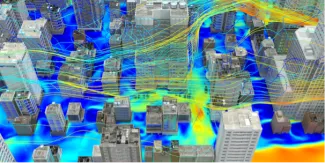
Computational fluid dynamics can be used to simulate the flow phenomena of gases or liquids. By simulating flow rates, pressures and other turbulence quantities, it is possible to improve the energy efficiency of data centers, safety of hydrogen power plants, indoor environmental conditions in residential and office buildings, or wind comfort in the built environment. With CFD, a virtual prototype corresponding to the physical reality can be produced in the early stages of design. This reduces risks in decision-making and guides the design in the right direction.
Realistic, accurate models and simulations require substantial computing capacity. Cloud computing services have their limitations e.g. the available runtimes may be too short for the modelling needs or using them may become expensive.
Solution:
“Workflows specifically optimized for HPC minimize the bottlenecks of computing. In his way, the resources required for CFD – in practice, several hundred processor cores – can be used for a large number of simultaneous computation tasks,” Eero Kokkonen, Department Manager and Principal CFD Engineer at Sweco Finland explains.
He also adds “For our clients, this translates into significant added value, in terms of design quality, schedules and costs”.
Business impact:
Obtaining the results of computational fluid dynamics simulations typically takes several days or even weeks. In practice, the supercomputer enables up to ten times higher efficiency and the use of more accurate models.
“It is indeed hard to imagine CFD without a high-performance computing environment,” says Kokkonen, who is an experienced user of HPC technology.
Benefits:
Benefits of modern technologies
Best possible tools for solving our clients’ challenges that require very specific expertise.
Added value in design quality and schedules
Cost-efficiency
Success story # Highlights:
Keywords: CFD, LUMI, simulations, engineering
Industry Sector: Manufacturing & engineering
Technology: HPC