
Image
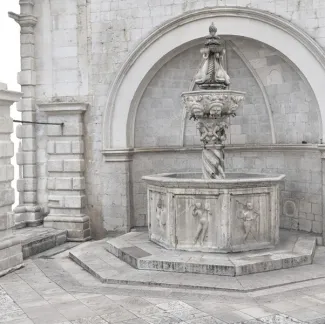
The digital preservation of cultural heritage often encounters technical challenges due to extremely large and complex datasets. A team of experts from the Ruđer Bošković Institute (RBI), the Croatian Conservation Institute, and the Faculty of Electrical Engineering and Computing of the University of Zagreb (FER) successfully addressed this challenge by applying high-performance computing (HPC) on the “Supek” supercomputer.
As part of the project, a demanding 3D reconstruction of the Small Onofrio’s Fountain in Dubrovnik was carried out, based on 2,136 high-resolution photographs with a total size of 26 GB. The photographs were taken by Ljubo Gamulin from the Croatian Conservation Institute using various cameras, lenses, and mobile phones, often in confined spaces. This heterogeneity of data significantly complicated photogrammetric processing, making the task an ideal candidate for the use of a supercomputer.
Based on previous experience, processing such a complex dataset on a standard computer would take more than a week. The aim of this Proof of Concept (PoC) was to examine whether the process could be significantly accelerated using a supercomputer and to develop a repeatable and scalable HPC workflow for future cultural heritage digitisation projects.
Under the supervision of Dr. Davor Davidović (RBI), FER student Vinko Đurić developed Python scripts that automate the execution of the commercial software Agisoft Metashape in a cluster environment. The solution enables parallel data processing across multiple nodes of the “Supek” supercomputer via the command line, fully leveraging the power of the HPC infrastructure. The project was further supported by the Faculty of Graphic Arts of the University of Zagreb, which provided the necessary software licenses.
The results exceeded expectations. Instead of multi-day processing, the entire workflow was completed in just a few hours. An exceptionally detailed 3D model with a size of 65 GB was produced and finalised in post-production by Branimir Kolarek (RBI). From this model, an orthographic image with an impressive resolution of 108,171 × 84,050 pixels was generated, suitable for conservation analysis, documentation, and further digital processing.
This project represents an important step toward the broader application of supercomputers in the field of cultural heritage. The team’s long-term vision is to enable experts to run such processes on remote HPC systems using their own computers and simple graphical user interfaces. In this way, the power of supercomputers would be brought closer to conservators, restorers, and researchers who do not possess specialised HPC knowledge.
The developed workflow can be easily adapted for 3D modelling of various objects, from monuments to archaeological finds, and lays a solid foundation for future systematic digitisation of Croatian cultural heritage using supercomputers.
The research was conducted by NCC Croatia with the support of the EuroCC 2 project and the Croatian Science Foundation through the HybridScale project.