Image
This blog post is the short version. The step-by-step material, with a page per machine, is the companion ENCCS lesson.
The EuroHPC Joint Undertaking now offers quantum computers that researchers and engineers from industry, SMEs and academia can apply to use and, if your application is granted, use free of charge. This blog post is a short practical guide to getting onboarded on three of them: Euro-Q-Exa at LRZ, Piast-Q at PCSS and VLQ at IT4Innovations. It links to the official documentation.
Important. Always refer to the official documentation for the most up-to-date details. The official pages are listed at the end of this post, and gathered in one table, Official links, by task, in the lesson.
Start with the overview. ENCCS's 2025 white paper, Quantum Computing in the EuroHPC JU Ecosystem: A Practical Guide for European SMEs, surveys the EuroHPC quantum computers.
How access works
Quantum access runs through the same EuroHPC access portal as classical HPC time, on monthly cut-offs rather than one annual deadline, so a missed date costs weeks. This holds at the time of writing.
Your proposal goes through a technical assessment: the hosting sites judge whether what you describe can run on their hardware. The form asks you to describe the problem and your needs, such as qubit counts, circuit depths, shot budgets and how you will handle noise, to name a few. If the assessment finds your workload feasible, you may be awarded time, though this can vary depending on other factors.
We recommend starting the proposal at least two weeks ahead, and contacting us, or your National Competence Centre (NCC), with questions in the meantime.
Official page: EuroHPC JU: Call for proposals for Quantum Access Pilot Mode.
Onboarding, per site
Once you are granted access, and at the time of writing, onboarding takes a separate process for each device you applied for. Yet there is one application and one portal. The diagram below shows the onboarding process so far for three of the devices.
Note. These steps may change going forward, as the hosting sites update their procedures. Check each site's official documentation for the current process. Keep an eye on my-eurohpc.eu for updates on access methods, and follow ENCCS on LinkedIn and here for further updates.
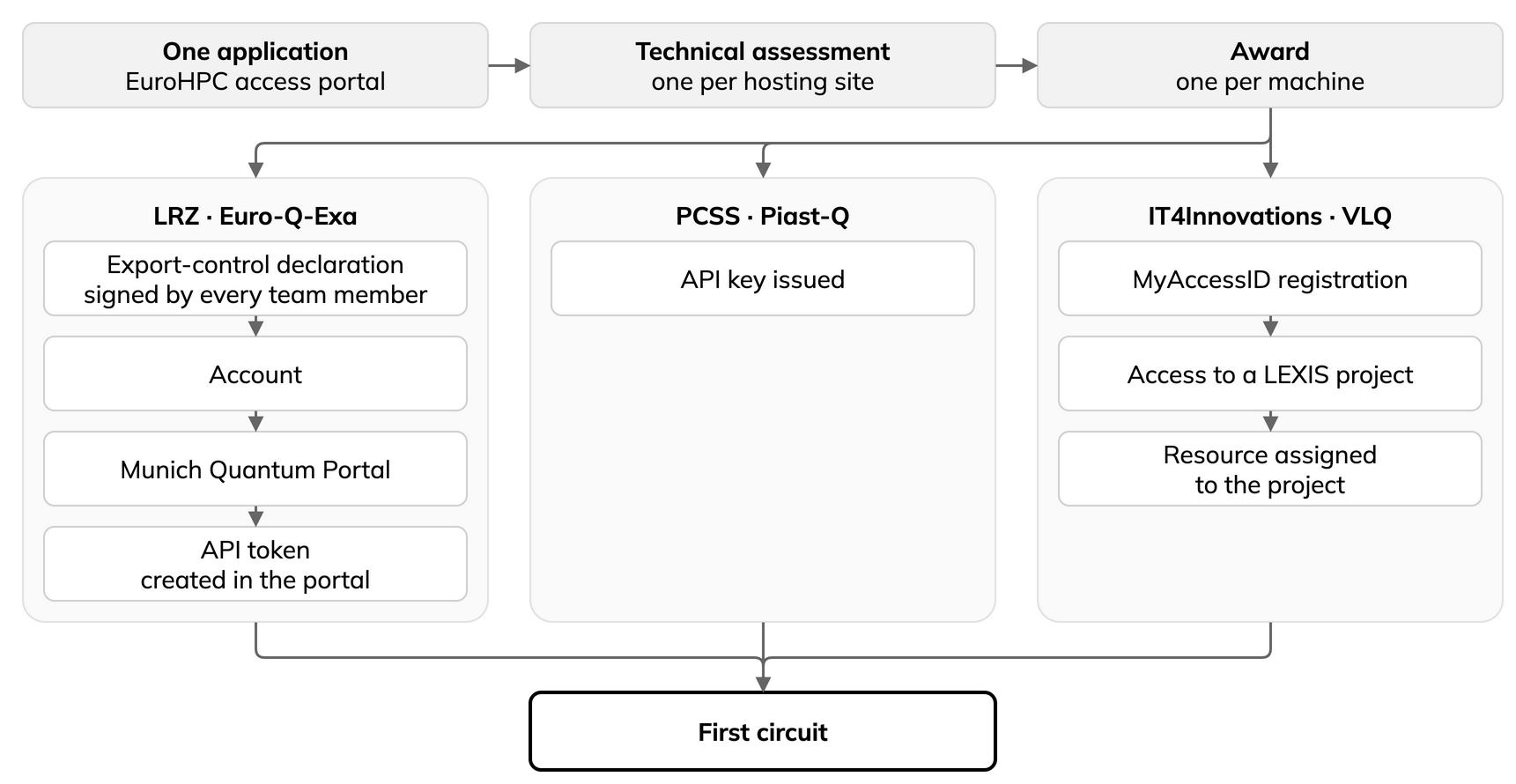 See the lesson for the details of this onboarding workflow per machine.
Three machines, three routes
The three machines are genuinely different, in ways that change what a circuit even looks like.
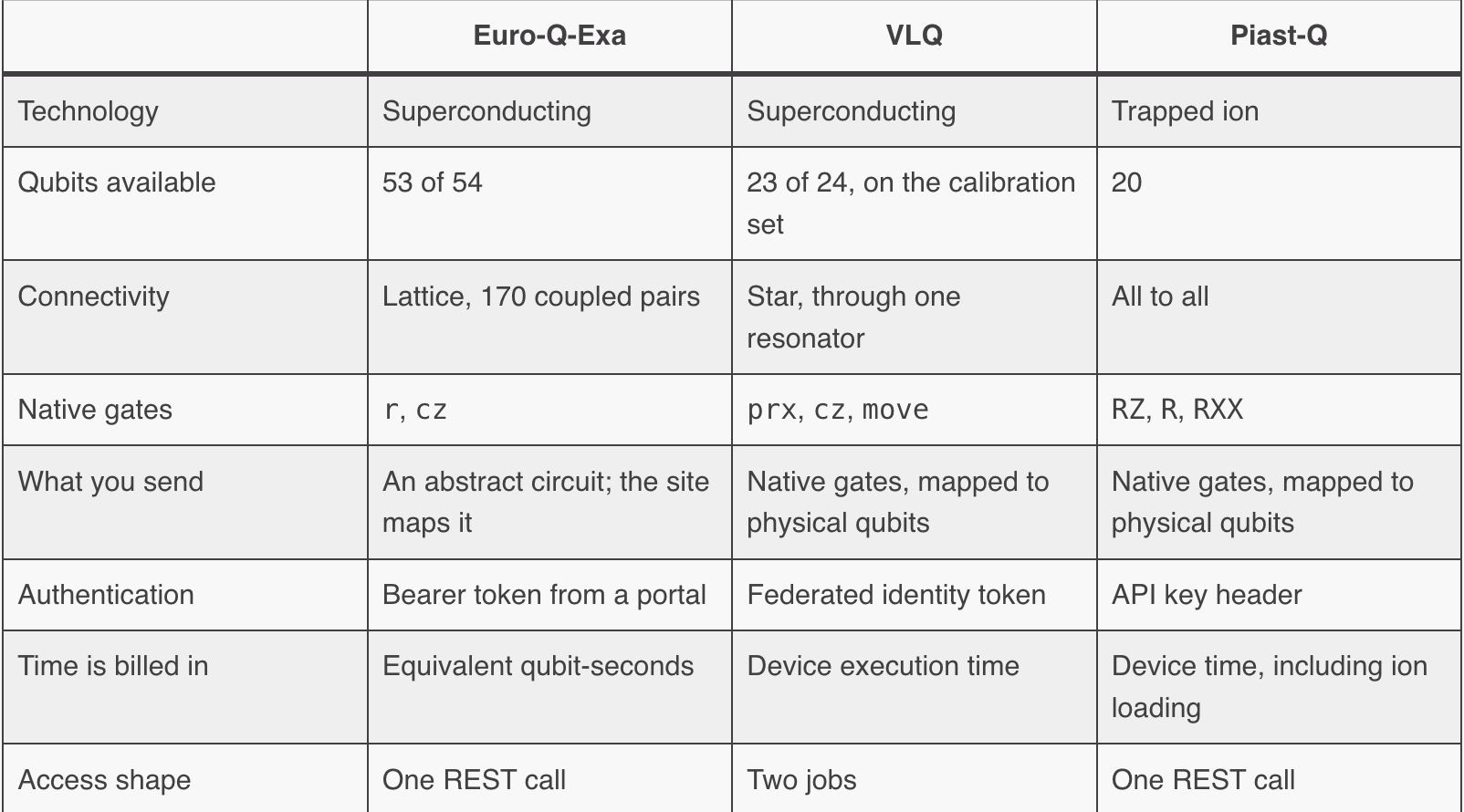
The row that matters most is what you send. On Euro-Q-Exa you can send an abstract circuit and the site maps it for you. On the other two you must send native gates, already mapped to physical qubits. The same Bell pair is three different objects. The following flow chart illustrates the differences.
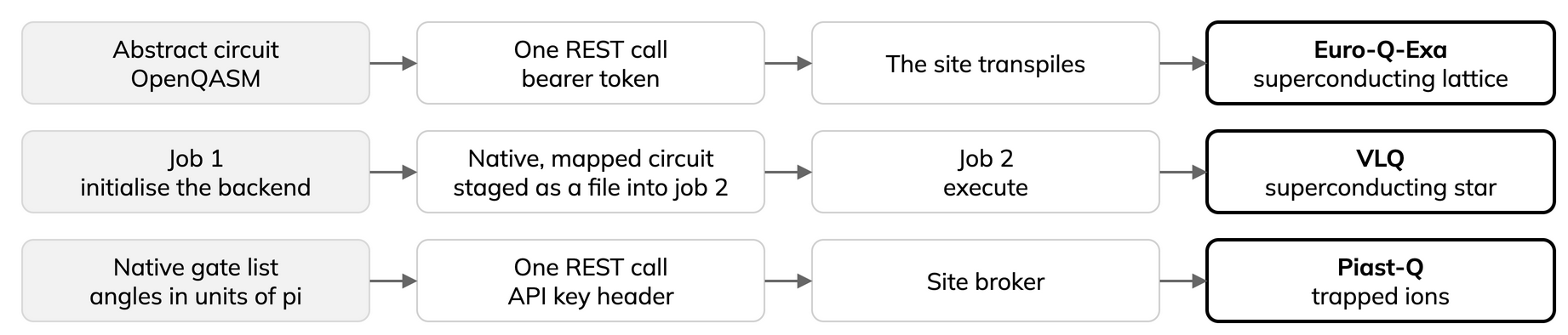 What you send and where you send it, for each of the three machines.
HPC and HPC-QC
EuroHPC JU describes its quantum computers as "hosted in Europe and tightly coupled to EuroHPC supercomputers" (Quantum Computing & Access). Its list of quantum computers names a hosting supercomputer for each: SuperMUC-NG for Euro-Q-Exa, ALTAIR for Piast-Q and KAROLINA for VLQ. Check the lesson for more details on each one and its connected supercomputer.
"QPU hours" on the devices
Each site measures and bills quantum time in its own way. The three definitions, with the full formulas, are on the lesson's QPU hours page. Meanwhile, classical resources are in node hours, as we are all used to. Sites could discuss them in GPU hours.
Where to read more
The overview and the lesson
- ENCCS: Quantum Computing in the EuroHPC JU Ecosystem: A Practical Guide for European SMEs (2025 white paper)
- ENCCS: EuroHPC JU quantum devices and HPC-QC access in practice (the companion lesson)
EuroHPC JU access
- EuroHPC JU: access portal
- EuroHPC JU: Call for proposals for Quantum Access Pilot Mode
- EuroHPC JU: Supercomputers Access Policy and FAQ
- EuroHPC JU: Quantum Computing & Access
- EuroHPC JU: Our Quantum Computers
LRZ, Euro-Q-Exa
- LRZ: Euro-Q-Exa
- LRZ: IDM-Portal 2
- LRZ: HPCQC System Access and HPCQC Job Submission via MQSS-Adapter
- LRZ: Definition of the computing unit for the LRZ Quantum Systems
- LRZ: Acknowledgement formulations
- Munich Quantum Portal
- Munich Quantum Software Stack: MQSS Interfaces Documentation
IT4Innovations, VLQ
- IT4Innovations: VLQ access documentation
- IT4Innovations: Estimating Consumption on VLQ
- IT4Innovations: VLQ Calibration API
- IT4Innovations: VLQ quantum computer
- IT4Innovations: Acknowledgments in publications
- LEXIS Platform: portal and login documentation
PCSS, Piast-Q
IQM and AQT, the machine vendors
- IQM: documentation and the IQM client, for Euro-Q-Exa and VLQ
- AQT: ARNICA public API documentation
Updates
Further reading
- Mansfield et al., "First Practical Experiences Integrating Quantum Computers with HPC Resources: A Case Study With a 20-qubit Superconducting Quantum Computer", arXiv:2509.12949, 2025
- Burgholzer et al., "The Munich Quantum Software Stack: Connecting End Users, Integrating Diverse Quantum Technologies, Accelerating HPC", arXiv:2509.02674, 2025
- Burgholzer et al., "Practical HPCQC Integration with QDMI: A Real-Hardware Case Study with IQM Systems", arXiv:2604.19869, 2026
- Farooqi et al., "Enabling Hybrid HPCQC Workflows with a Heterogeneous Software Stack", arXiv:2608.14827, 2026
Acknowledgement
This work used EuroHPC Joint Undertaking quantum resources awarded under the Quantum Access call, hosted by LRZ, IT4Innovations and PCSS. We thank the support teams at all three sites.
Each site asks for its own wording, reproduced here as supplied:
We acknowledge EuroHPC JU for awarding project with ID 22/2026 access to the EuroHPC allocation on the Piast-Q trapped-ion quantum computer hosted by the Poznan Supercomputing and Networking Center
The authors gratefully acknowledge the use of the quantum system Euro-Q-Exa, co-funded by the EuroHPC JU, BMFTR (grant 13N16690), and the Bavarian State Ministry of Science and the Arts, operated by the Leibniz Supercomputing Centre (LRZ) in Garching, Germany, for providing the computational resources for this work.
This work was supported by the Ministry of Education, Youth and Sports of the Czech Republic through the e-INFRA CZ (ID:90254)
- For LRZ's wording, open: LRZ: Acknowledgement formulations
- For IT4Innovations' wording, open: IT4Innovations: Acknowledgments in publications