
Image
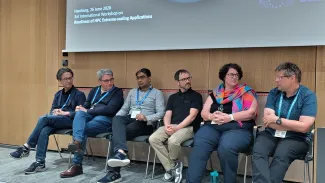
The 3rd edition of the workshop on “Readiness of HPC Extreme-scaling Applications” organised by the CoE POP3 during the ISC 2026 looked into questions related to scaling applications and the increasing role of AI in the big picture from different angles – predicting the workload and appropriately designing the next Japanese Supercomputer FugakuNEXT (Yasumichi Aoki, RIKEN, Japan) and a look into the UK landscape of large-scale GPU systems (Andrew Turner, EPCC, UK), looking into the challenges of scaling applications for such systems, namely hydrological simulations with Parflow used in EoCoE III (Muhammad Fahad / FZJ, Germany), and earthquake modelling with SeisSol, used in CoE ChEESE-2P (Iris Christadler, LMU, Germany), using co-design and mini-apps from several CoEs to shape the next generation of European chips and systems (Erwan Raffin, BULL, France), employing the EESSI platform to ease deployment of HPC codes to large systems (Lara Peeters, U Gent, Belgium) and an investigation how applying performance analysis tools used for decades by the HPC community could improve also the efficiency of AI workloads (Jesus Labarta, BSC, Spain).
After the presentations, speakers were invited to a panel discussion chaired by Guy Lonsdale (scapos AG, Germany) on behalf of the CASTIEL 3 project. He opened – somewhat tongue-in-cheek by referring to the running Football world cup – by asking the participants whether they saw themselves already as “group winners” in the goal of exascale readiness. Despite all progress that has been made, there is still a lot of headway to make. One of the large uncertainties concerns the portion that AI workloads will play in future usage and how it will shape performance characteristics in leading-edge hardware, and how HPC workloads may adapt to the changing landscape. Jesus Labarta contributed his observation of what could be called a cultural difference between typical users or developers of classical HPC applications vs AI-oriented workloads: While the use of performance tuning to squeeze out the last few percent of efficiency is more common among the former, the latter often take the efficiency of the tools as a given and care more about memory issues. Yet, he showed in his presentation that efficiency improvements to standard AI workflow components seem indeed possible.